
Worldschooling: Real Examples From Our 100-Day Family Trip


When people talk about worldschooling, it's easy to focus on the benefits children gain, such as resilience, independence, adaptability, and cultural awareness.
We even wrote about the life skills our daughters developed during our 100-day family sabbatical in our post, Beyond the Classroom: Worldschooling Life Skills Our Kids Learned from 100 Days of Travel.
However, when we were researching our own trip, we found it much harder to find practical, real-world examples of what worldschooling actually looked like day to day.
Most articles focused on the outcomes, but few explained how families were creating learning opportunities while travelling. What activities were they doing? How were they teaching subjects like geography, maths, history, and science without trying to recreate school on the road?
As we planned our trip, these were exactly the kinds of examples we were looking for.
The reality is that our version of worldschooling didn't revolve around lesson plans, worksheets, or setting aside hours each day for formal learning. Instead, we looked for opportunities to connect what we were seeing and doing with subjects the girls were already learning at school.
Sometimes that meant giving them currency conversion cards and asking them to estimate the cost of lunch. Other times it meant handing over a hiking map and letting them navigate a trail, discussing tectonic plates at a museum, or learning about the Vietnam War while exploring the Cu Chi Tunnels.
Many of these moments lasted only a few minutes, but they helped reinforce classroom concepts in a way that felt relevant, memorable, and engaging.
This post is a collection of those moments.
We're sharing real examples of how we incorporated learning into our travels through Asia, Australia, and New Zealand with our daughters, aged 8 and 10.
Throughout the post, we’ve linked to the daily diary entries we wrote on the road. Each one covers the full day in much more detail, with lots of photos, so if a particular example catches your eye, you can click through to see exactly what we did.
None of these ideas required special training, elaborate planning, or expensive resources. They were simply small ways of using the experiences we were already having as a family to spark curiosity, ask questions, and encourage learning.
Whether you're planning a long-term family adventure, a shorter sabbatical, or even just a family holiday, we hope these examples provide some inspiration for your own journey.
This post may contain affiliate links. If you click through and make a purchase, I may earn a small commission at no extra cost to you. We only ever share honest reviews of products and experiences we genuinely love.
What is Worldschooling?
Worldschooling is the idea that the world itself can be the classroom.
Rather than learning solely through textbooks and worksheets, children learn through what they see, do, and experience, whether that's navigating a city, exploring a museum, visiting a historical site, or simply interacting with different people and cultures.
For some families, worldschooling is a full-time lifestyle that replaces traditional schooling altogether. For others, it's something they embrace during a family sabbatical, extended trip, or even a two-week holiday. Our approach sat somewhere in the middle.
Our daughters were enrolled in school in Calgary before we left and would return when we came home, so our goal was never to replace their education.
Instead, we wanted to keep the fundamentals ticking over while using our travels to bring many of the things they were already learning to life.
Our Approach: Worldschooling Without a Curriculum
Before we left, we decided that we weren't going to try to recreate school on the road. This wasn't full-time homeschooling while travelling; the girls were still enrolled in school back home.
With 100 days and ten countries, a rigid timetable would have made everyone miserable (parents included).
Instead, our approach had two parts.

A little structured learning
We kept core skills ticking over, mainly maths, reading, and writing, using online workbooks, work set by their school, and a handful of online resources.
Jessica's teacher also set her a video diary project, which she worked on throughout the journey.
Rather than scheduling lessons, we fitted learning into the natural gaps in our itinerary: slower mornings, the rest days, airport lounges, hotel lobbies, and wherever else we happened to find a spare hour or two.
We were fortunate to spend two weeks in both Thailand and Indonesia with my parents, both of whom happen to be teachers. They helped keep the girls on track with core subjects such as maths and English.
A lot of learning through travel itself
In many ways, that's what this post is all about: sharing real examples of how learning opportunities emerged throughout our travels.
Sometimes those opportunities were intentionally chosen, such as visiting the War Remnants Museum in Ho Chi Minh City, taking a natural dyeing class at Ock Pop Tok in Luang Prabang, or attending the Dark Sky Experience at Lake Tekapo.
Just as often, however, the best learning happened unexpectedly. A temple visit became a history lesson, a market stall became a maths lesson, and a question about something we had seen sparked a conversation that led us down an entirely new path of learning.
The examples below are some of the ways those moments played out during our 100 days on the road.
Geography Worldschooling Examples
Geography covers far more than simply knowing where countries are on a map. It includes understanding the world around us, from continents and borders to landscapes, rivers, mountains and cities.
Understanding World Maps

Before we left, our daughters knew roughly where the UK and New Zealand were thanks to family connections, but had very little idea where the Asian countries on our itinerary were. Here's how we helped bring maps to life:
Testing Their Knowledge with a Blank Map: Before setting off on our journey, we tested the girls' knowledge by printing out a blank world map and asking them to fill in as many countries as they could. The girls found it a fun, slightly competitive family activity. You can download a free printable blank world map here.
Practising Country Names with Online Quizzes: One of our favourite ways to practise geography on the road was using Sporcle's country quizzes. They're free, and a great way for kids (and adults!) to test their knowledge of world geography. We started with Asia-specific quizzes so the girls could learn the countries we would be visiting.
Map Reading & Navigation
Navigation has changed dramatically since we first travelled through Asia in 2006. Back then, we relied on printed street maps, guidebooks, and scribbled directions from other travellers. Today, Google Maps makes navigation infinitely easier.
We wanted the girls to embrace the technology available to them, but also to understand what was happening behind the screen.
Reading Trail and Transit Maps: Whenever we came across trail or transit maps, we'd ask the girls to work out where we were and where we were heading next. They learned to read map symbols, understand contour lines, and use landmarks to navigate.
Planning Routes with Google Maps: In busy cities like Hong Kong, Tokyo, and Hanoi, learning to navigate with a map is a valuable life skill. We often let the girls plan the route. They compared options, estimated travel times, decided whether to walk or use public transport, and then tracked our progress as we travelled.
Physical Geography: Mountains, Rivers & Glaciers
One of the easiest parts of worldschooling is teaching physical geography because you're standing right in the middle of it. Rather than reading about rivers, mountains, glaciers, or tectonic plates in a textbook, our daughters were able to see these landscapes up close and learn about how they were formed.

Learning How Rivers Support Communities: While travelling from Laos to Thailand, we took the two-day slow boat up the Mekong River. With hours spent on the water, it was the perfect opportunity to talk about one of Asia's great rivers. We discussed why major rivers are important for trade and transport, and how local communities still rely on them for their livelihoods.
Seeing How Glaciers Shape the Land: New Zealand's South Island provided countless opportunities to learn about mountains and glaciers. Around Aoraki / Mount Cook, we talked about how glaciers carve valleys, transport rock, and shape the landscape over thousands of years. It was also immediately apparent how far the Mueller Glacier had retreated, which led to a great conversation about climate change.

Reading Rock Formations: New Zealand is a living geology lesson.
The Clay Cliffs near Omarama reminded us of Alberta's Drumheller badlands, only taller and more dramatic, and gave us a chance to talk about how rocks can be shaped by erosion.
At Castle Hill, near Arthur’s Pass, the girls clambered over huge limestone boulders that were once part of an ancient seabed, a landscape so striking it was used as a filming location for The Chronicles of Narnia.
Another example was at Punakaiki in the South Island, where the layered limestone of the Pancake Rocks showed how rock forms in layers over millions of years.

Discovering How Caves Form: Gliding through nine caves on the Trang An boat tour in Vietnam and walking through Ruakuri Cave at Waitomo in New Zealand gave the girls a close look at how water carves out caves over time. At Ruakuri, they learned to tell stalactites from stalagmites and even watched a glowworm catch its dinner.

Understanding Earthquakes and Volcanoes: New Zealand sits on the boundary of two tectonic plates, making it an ideal place to learn about earthquakes and volcanoes.
At Te Papa in Wellington, the girls learned how tectonic plates move and why earthquakes occur. We even stepped inside a room that simulated a real earthquake.
Later in the trip, we found seashell fossils in the rock at the top of Te Mata Peak, 400m above sea level, which was a perfect way to explain how tectonic plates push land upwards.
On the Craters of the Moon walk near Taupō, the girls saw steaming vents and bubbling mud pools that show how much activity is happening just below the surface.
Maths Worldschooling Examples
Maths is one of the easiest subjects to incorporate into travel because it appears naturally throughout the day.
Whether calculating exchange rates, managing a budget, or working out time differences, maths suddenly has a practical purpose. Many of our best maths lessons happened without the girls even realising they were learning.
Managing Money While Travelling

There are few more important life skills than understanding money and how to manage it effectively. Travel creates countless opportunities for children to practise budgeting, estimation, multiplication and problem-solving in real-world situations.
Managing the Daily Food Budget: As our daughters were only 8 and 10 when we travelled, we started by giving them responsibility for small parts of the budget, such as managing the dinner budget for a day. The girls quickly became invested, often reminding dad that he "couldn't afford" another beer! It was also a great opportunity to practise estimation. If the day's food budget was $100, how much should we roughly spend on breakfast, lunch and dinner?
Converting Prices in Their Heads: Converting currencies became a daily maths lesson. We gave the girls a written conversion table so they could make rough calculations in their heads on the spot without continually asking. We tried to leave them to it at markets, keeping a close eye to make sure they'd worked it out correctly and weren't paying more than they should. At Orussey Market in Phnom Penh, Evelyn even bought a set of foreign-currency play money, which became a handy maths tool for the rest of the trip.
Bargaining at Local Markets: Local markets provided some of the best opportunities to put their new-found currency conversion skills into practice. Their first experience of bargaining came at Hong Kong's Ladies' Market, where they quickly discovered that the first price isn't always the final price!
Science Worldschooling Examples

Science is everywhere when you travel, from the stars overhead to the food on your plate. Some of the girls' favourite experiences of the whole trip turned out to be science lessons in disguise.
Space and Astronomy

Learning About the Night Sky: Lake Tekapo sits within one of the world's largest dark sky reserves, making it the perfect place to learn about astronomy. When clouds cancelled our stargazing plans, we booked the indoor Dark Sky Experience instead. It combined the science of the Big Bang with Māori creation stories and traditional methods of navigating by the stars.
Exploring Space Through Hands-On Exhibits: In Wellington, the girls spent an afternoon at Space Place with their uncle, trying out its interactive astronomy exhibits. They came back full of facts to share.

How Things Are Made
Some of the most fun science lessons came from seeing everyday products being made from scratch.

Learning How Chocolate Is Made: At the Siamaya Chocolate Workshop in Chiang Mai, the girls learned how cacao is harvested, fermented, dried and roasted. They compared craft chocolate with big-brand bars in a taste test, then made and decorated their own.
Discovering How Paper Is Made: At Elephant Poopoopaper Park in Chiang Mai, we followed the process of turning elephant dung into paper, step by step. It was as educational as it was hilarious, and the girls finished by decorating their own paper crafts.
Finding Out Where Rubber Comes From: On Koh Lanta in Thailand, spotting rubber trees being tapped by the roadside sparked a conversation about where rubber comes from. None of us knew much about the process, so that evening we watched a Maddie Moate video to learn how latex is harvested and turned into rubber.

Museums Worth Planning Around

Museums help to bring science to life, and the best ones let children touch, test and explore rather than just read.
Getting Hands-On with Dinosaurs: The Queensland Museum in Brisbane had some impressive dinosaur and megafauna exhibits, as well as staff-led sessions where the girls handled turtle shells and stick insect eggs, and even watched leaf insects wiggle like leaves in the breeze when gently blown on.
Discovering Ocean Life: At Te Papa in Wellington, beyond the earthquake room, the girls were fascinated by the colossal squid, which had been accidentally caught by a fishing vessel in Antarctic waters and carefully preserved for display.

History Worldschooling Examples
History often gets taught through textbooks and timelines, but travel allows children to experience it firsthand.
Walking through ancient temples, exploring historical sites, and standing in places where major events unfolded helped bring history to life for our daughters in a way that felt far more tangible and memorable than simply reading about it in a book.
War and Historical Conflicts

War is an important part of history, but it can be a challenging topic to approach with children. We found it was important to balance learning about significant historical events with ensuring the content was appropriate for their age and maturity level.
Crawling Through Wartime Tunnels: One of the most memorable history lessons came from visiting the Cu Chi Tunnels near Ho Chi Minh City. The girls discovered how the Viet Cong used the tunnels during the Vietnam War and gained a better understanding of how ordinary people were affected by conflict. The tunnels' narrow dimensions, the heat, the claustrophobic conditions, and the ingenuity of the guerrilla tactics used there left a lasting impression on all of us.
Learning How War Affected Everyday Life: Some of the photography at the War Remnants Museum in Ho Chi Minh City was very graphic, so I walked through each room first to decide what the girls should and shouldn't see. Even when we chose not to show them certain exhibits, we still tried to explain what they contained, helping the girls understand the realities of war in an age-appropriate way.
Deciding When They're Ready: Not every historical site is right for every child. In Cambodia, we felt the Killing Fields and the Tuol Sleng Genocide Museum (S-21) would be too confronting for our daughters at their age, so we chose not to visit them. I did visit both on my own and found them incredibly difficult. On reflection, I think the girls could have managed S-21 with the same approach we used at the War Remnants Museum, but skipping the Killing Fields was the right call. That said, every child is different, and ultimately it's up to each parent to decide what is age-appropriate and what their children are ready to process.

Learning About Landmines: An age-appropriate way to learn about the long shadow of war in Cambodia was visiting APOPO's Hero Rats in Siem Reap. The girls learned about how African giant pouched rats are trained to sniff out landmines. We watched a live demonstration in a practice minefield and even got to hold the rats.

Ancient Civilizations and Religions

Some of our favourite history lessons came from visiting temples, shrines, and religious sites throughout Asia. These places offered a glimpse into civilizations that flourished hundreds or even thousands of years ago.
Coming from Canada, where much of the built history is relatively recent, it was remarkable for the girls to stand inside temples that were already centuries old before Europeans first arrived in North America.
Walking Through a 1,000-Year-Old Empire: Exploring Angkor Wat and the wider Angkor Archaeological Park gave the girls an introduction to the Khmer Empire and one of the world's most impressive historical sites. It was genuinely incredible, and being able to see, walk through, and touch a structure that has stood for almost 1,000 years is something I hope stays with them forever. You simply can't get that experience from a textbook or video.
Learning About Samurai and the 47 Ronin: At Sengaku-ji Temple, we visited the graves of the 47 Ronin and the girls learned about the story of their loyalty and revenge, one of Japan's most famous tales. A few days later, they saw real samurai armour at the Tokyo National Museum.

Learning Local Beliefs Through Temples: From the Big Buddha in Hong Kong to the temples of Japan, Laos and Bali, each site offered a window into local beliefs and history. The girls saw people praying, making offerings, and taking part in rituals that were very different from those back home, prompting lots of conversations about different religions and the role religion has played in shaping societies throughout history.

Colonial History and Cultural Change
Travel also helped us explore how countries have changed over time and how outside influences have shaped the places we see today.
Exploring Colonial History: Visiting Victoria Peak and exploring Hong Kong created opportunities to discuss its history as a British colony and the transition back to Chinese sovereignty. The topic is especially relevant to our family, as Susie was born in Hong Kong before her family emigrated in the 1980s.
Understanding How Settlement Changed a Country: In New Zealand, we discussed both Māori history and the arrival of European settlers. We learned about how settlers brought new animals with them, and because New Zealand's native birds had evolved with no land predators, many species like the kiwi and takahē are now endangered.
English & Language Arts Worldschooling Examples
Travel provided countless opportunities to build reading, writing, and communication skills. From keeping journals of their adventures to presenting what they had learned, our daughters were constantly finding ways to practise and refine how they expressed themselves.
Travel Journals & Reflective Writing

Keeping Travel Journals: We encouraged the girls to keep journals throughout our travels. I'll be honest, it was challenging to get them to write every day, but adding ticket stubs, brochures, maps, photos, coin rubbings, and other souvenirs made it much more engaging. Over time, their journals became personal records of the trip and a natural way to practise writing and reflection.
Writing About Major Experiences: Occasionally, we'd give them a more structured writing task similar to something they might receive at school. After major experiences such as visiting Angkor Wat, we'd ask them to write a page describing what they saw, what they learned and what they found most interesting.
Reading & Storytelling

Following a Story from Book to Film to Real Life: Before we left, the girls' uncle recorded himself reading The Hobbit as an audiobook, and they listened to it throughout the trip. In New Zealand, we watched the Lord of the Rings films as a family, and then visited the Hobbiton movie set, where a guide explained the filming tricks used to make hobbits look small. Seeing a story go from book to film to a real place was a wonderful way to show them how stories are brought to life.
Communication & Presentation Skills

Making a Video Presentation for School: While we were travelling, Jessica's teacher asked her to create a video presentation about parts of our trip. Putting it together required her to organise information, select photos and videos, write narration, and present ideas clearly. It was a great exercise in both presentation skills and digital media literacy.
Languages: Real Worldschooling Examples
Travel shows children languages in action. Instead of learning vocabulary from a worksheet, children hear native speakers, read signs, and navigate menus, discovering firsthand that people communicate in different ways.
Learning Local Languages

You don't need to become fluent in a language to learn from it. Simply being exposed to different languages encourages curiosity, confidence, and cultural awareness.
Learning Basic Phrases: In each country we visited, we encouraged the girls to learn a few simple words and phrases such as "hello", "thank you", and "goodbye". Using these with locals helped build their confidence and showed them the value of making an effort to communicate in another language.
Helping Others Learn English: In Luang Prabang, we joined a free English conversation session at Big Brother Mouse, a local literacy organisation that publishes books in Lao and English. For an hour and a half, the girls chatted with local teenage students, one of whom had travelled over an hour to be there. It turned the usual language lesson on its head: this time the girls were the native speakers, and it showed them how much effort others put into learning a language they take for granted.

Recognising Different Writing Systems: Travelling through countries like Japan, Hong Kong, and Thailand exposed the girls to writing systems that looked completely different from English. Seeing unfamiliar characters on signs, menus, train maps, and information boards sparked discussions about alphabets, symbols, and the many ways people represent language in writing. At the Nara Visitor Centre, a free lesson explained that more than 50,000 kanji characters exist, but only around 2,400 are in everyday use.

Trying Japanese Calligraphy: Beyond simply seeing different writing systems, the girls had the chance to experience the cultural traditions surrounding them. In Japan, they tried traditional calligraphy using brush and ink, learning that writing can be an art form as well as a means of communication. They practised during our Homecoming TAKA class in Tokyo and again at the Nara Visitor Centre. At Sengaku-ji Temple, they also copied a Buddhist sutra by hand before receiving their first goshuin (temple stamp), beginning a stamp-collecting habit that lasted the rest of the trip.

Cultural Studies Worldschooling Examples
One of the biggest benefits of long-term travel is cultural immersion. While geography teaches children where places are and history explains how they came to be, culture helps them understand how people live today. Our daughters experienced different customs, religions, foods, traditions, and ways of life almost every day during our trip.
Understanding Different Cultures
Learning About Māori Culture: While visiting New Zealand, we spent time learning about Māori history, traditions, and beliefs. We were lucky enough to have a Māori guide take us around Te Papa Museum, where she explained the significance of various cultural artefacts, Māori customs, and the importance of whakapapa (genealogy) in Māori culture. She even sang a traditional waiata for us, bringing many of the stories and traditions to life.
Connecting to Indigenous Cultures at Home: Returning home to Canada also provided opportunities to continue these conversations. Learning about Indigenous cultures abroad helped the girls better appreciate the histories, traditions, and ongoing contributions of First Nations, Inuit, and Métis peoples in Canada.
Visiting a Village School: On the Mekong slow boat, we stopped at Ban Paksith, a small riverside village, for a short guided visit that included the local school. Seeing a classroom so different from their own in Calgary was a real eye-opener for the girls. I’ll admit the visit felt a little awkward, as stops like this can tip into treating people’s daily lives as a tourist attraction, but it was a great learning experience for the girls.

Religion & Spirituality

Religion is deeply connected to the history and culture of many of the places we visited. Travelling through Asia gave us countless opportunities to discuss different belief systems in a respectful and age-appropriate way.
Seeing Faith in Everyday Life: One of the advantages of travel is that children can see religion being actively practised rather than simply learning definitions. The girls saw fruit, flowers and incense left as offerings at Ngoc Son Temple in Hanoi, used bamboo ladles to perform ritual cleansing at temples and shrines before entering sacred spaces, and took part in a water purification ceremony at a temple in Bali. It showed them how religion influences daily life throughout much of Asia.

Learning Through Questions: Visiting so many different religious sites prompted lots of discussions. Why do some religions have statues while others don't? Why do people remove their shoes before entering temples? Why are certain animals considered sacred? These conversations often led to broader discussions about respect, belief, and cultural traditions.
Arts & Traditions
Some of the girls' most memorable cultural lessons came through hands-on experiences. Food, crafts, and art provided natural opportunities to learn about the traditions, values, and creativity of the places we visited.
Learning About Culture Through Food: Food was often our first introduction to a new culture. In Hanoi, we ate at Bún Chả Hương Liên, better known as “Obama Bún Chả,” where President Obama and Anthony Bourdain shared a meal in 2016. The photos of their visit still hang on the walls of the restaurant. It's a reminder that even a simple bowl of noodles can tell a much bigger story about a country's history, culture, and place in the world.

Learning to Cook Local Dishes: Two of our most memorable experiences were cooking classes, one in Japan and one in Thailand.
At Homecoming TAKA in Tokyo, a local family welcomed us into their home, where the girls made udon dough, rolled sushi, and fried vegetable tempura. The class also included folding origami cranes and a traditional matcha tea ceremony. Beyond simply preparing a meal, the girls learned about ingredients, presentation, etiquette, and the importance of food in Japanese culture.
On Koh Lanta, we celebrated my birthday by returning to Lanta Thai Cookery School, where Susie and I had taken a class back in 2011. This time Jessica and my dad joined us to cook golden cups, pad thai, hot basil stir-fry and khao soi. The khao soi was such a hit that Jessica now asks for crispy noodles at home.

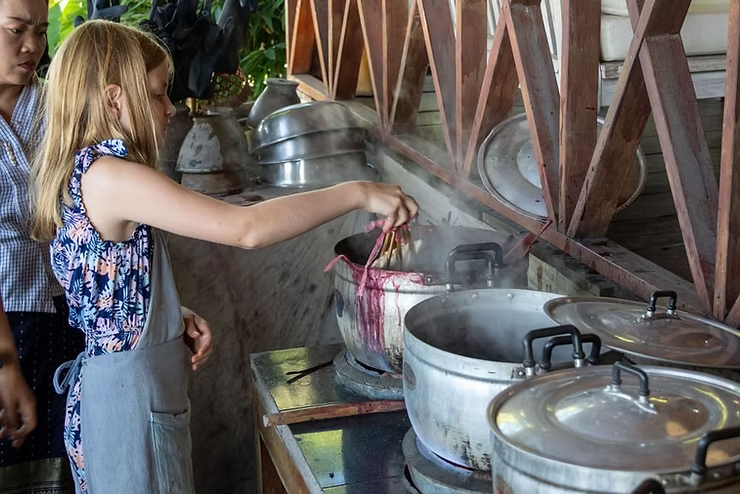
Trying Traditional Crafts: At Ock Pop Tok in Luang Prabang, the girls learned how plants, roots and bark are turned into natural dyes and tie-dyed their own shirts, and at our hotel nearby they made layered soy-wax candles.
Exploring Modern and Digital Art: The girls also discovered that art isn't only traditional. At TeamLab Planets in Tokyo, we waded barefoot through water filled with digital koi that responded to movement, challenging our ideas about what art can be and how people can interact with it.

Environmental Studies Worldschooling Examples
Encountering different animals and ecosystems helped bring environmental studies to life. These experiences often led to conversations about habitats, biodiversity, and the importance of protecting the natural world.
Wildlife and Conservation

Seeing Animals in Their Habitats: Watching wildlife in its natural environment brought many of the girls’ animal studies to life.
Spotting Koalas in the Wild: Seeing a koala was Evelyn’s dream, and Australia delivered three ways. At Lone Pine Koala Sanctuary, we learned about koala care up close. At Daisy Hill Koala Centre, a ranger talk and feeding demonstration taught us what koalas need to survive. Best of all, on a free walk at Whites Hill Reserve, we spotted five koalas in the wild!

Learning Each Elephant’s Story: At the Following Giants ethical elephant sanctuary in Thailand, we walked alongside the elephants rather than riding or bathing them. Our guide explained each elephant’s history. Many had worked in logging or riding camps and still carried injuries from hooks.
Learning About Endangered Species: At the Te Anau Bird Sanctuary, the girls saw the takahē, a flightless bird with only around 300 left in the world. Like the kiwi, it evolved without predators, which is why introduced species hit it so hard.
Watching Dolphins in Milford Sound: On our Milford Sound cruise, a pod of bottlenose dolphins swam right up against the boat. Only about one cruise in four sees them, so we were lucky. We also spotted New Zealand fur seals resting on the rocks.
Choosing Ethical Wildlife Experiences: Not all wildlife experiences are created equal, and some of the most valuable lessons came from discussing the attractions we chose to avoid. We talked a lot about ethical tourism, animal welfare, and the role conservation plays in protecting wildlife for future generations. For example, we chose not to visit Tokyo's Ueno Zoo due to animal welfare concerns and avoided attractions such as Chiang Mai's Tiger Kingdom. It wasn't always an easy decision, as the girls naturally wanted to see the animals, but it provided an opportunity to explain why some experiences can do more harm than good.
Understanding How Animal Rescue Works: At Lanta Animal Welfare on Koh Lanta, the girls learned that helping street dogs is about much more than adoption. The centre’s main work is neutering and population control, which stops the problem growing in the first place.

Getting Our Hands Dirty
Some of the best lessons came from rolling up our sleeves and seeing how things work up close.

Learning How Rice Gets to the Table: At Living Land Farm near Luang Prabang, the girls learned the 14 steps it takes to turn a rice seedling into sticky rice. They planted seedlings knee-deep in mud, Jessica had a go at ploughing with a water buffalo, and we finished by making fresh sugarcane juice.
Getting Hands-On at a Buffalo Dairy Farm: At the Laos Buffalo Dairy Farm near Kuang Si Falls, the girls saw what goes into running a working farm. They washed the buffalo, bottle-fed the calves, and tried milking a water buffalo. We finished with the farm’s buffalo-milk ice cream, the reward for all that work!

Physical Education & Healthy Living
Between city walks, viewpoint climbs, temples and swimming, the girls were often more active on the road than in a normal school week. Travel also gave them sports and challenges they’d never have tried at home, which built their confidence along the way.
Adventure and Outdoor Activities

Earning the View on Hikes and Climbs: Whether it was climbing the 500 steps at Mua Caves in Vietnam, tackling hiking trails in New Zealand, or spending entire days exploring cities on foot, the girls quickly learned that some of the best views require a bit of effort. As children who weren't used to being this active on a daily basis, it wasn't always easy, but these experiences helped build both physical endurance and mental resilience.
Keeping Cool and Active in the Water: Water-based activities are a great part of any family trip, especially in hot climates. Activities like snorkelling and daily swimming help keep kids active, build their confidence in the water, and provide a welcome break from the heat. One of our favourite memories from Hong Kong was spending the evenings swimming in the pool at the JW Marriott after a day of exploring the city.
Exploring by Kayak: Kayaking in Paradise Bay in New Zealand's Marlborough Sounds gave the girls a chance to stay active while exploring the outdoors. Spotting a stingray gliding beneath our kayaks made the experience even more memorable.
Walking Everywhere: One of the biggest differences from life at home was simply how much we walked. Whether navigating Tokyo train stations, exploring Hong Kong, or wandering through temple complexes in Cambodia, the girls regularly covered 15,000-20,000 steps a day, far more than they were used to. What initially seemed daunting soon became normal, building both their stamina and confidence.
Sports and Physical Culture Around the World
Trying a Local Game: In Phnom Penh, we watched locals playing Sei, a game of keepy-uppy using a shuttlecock with your feet. I had a go and quickly discovered it's much harder than it looks. It was a fun reminder that every culture has its own games and sports.
Watching Live Sport: On our final day in Auckland, we chose the ASB Classic tennis tournament over more sightseeing. Watching professional players up close was a highlight, especially for Jessica, who used to play competitively, and a great way to end the trip.

Final Thoughts

Looking back, very little of our daughters' learning on the road came from workbooks. Most of it came from engaging with the world around them, whether through new experiences, unexpected challenges, or simple day-to-day discoveries. The structured work kept the basics ticking over. The trip itself did the real teaching.
The biggest lesson for us as parents was that worldschooling doesn’t need to be complicated. You don’t need a curriculum, a teaching background or a year off work. Most of the examples in this post took just a few minutes and happened alongside things we were already doing as a family. The trick is simply to slow down, hand over the map or the budget now and then, and follow the questions your kids ask.
If you’re planning a trip of your own, whether it’s 100 days or a two-week holiday, we hope these ideas give you a starting point.
And if you’d like to read about the bigger picture, our post Beyond the Classroom: Worldschooling Life Skills Our Kids Learned from 100 Days of Travel covers the resilience, independence and confidence the girls brought home with them. For the practical side of taking a career break with kids, start with our sabbatical planning guide.
Have you tried worldschooling with your own family? We’d love to hear your favourite real-life learning moments in the comments.


Comments