.png)
Beyond the Classroom: 10 Worldschooling Life Skills From 100 Days of Travel


You can teach kids a lot in a classroom, but there are some things you can never learn from a textbook: what to do when a flight gets cancelled at midnight, when nobody around you speaks English, or when the day's plan falls apart before breakfast.
Over 100 days on the road, the girls learned plenty. Looking back, though, the lessons that stayed with them weren't tied to worksheets or schedules. They came from real situations that demanded patience, confidence, curiosity, and resilience.
They came from missed flights, unfamiliar food, long travel days, and all the little moments in between.
It's worth saying plainly, too: not every day felt like a valuable life lesson. Many mornings homeschooling simply didn't happen, plans changed more often than we'd have liked, and there were tired, emotional stretches where we were just trying to get through the day.
That being said, here are ten worldschooling life skills that the girls took away from the trip, along with the moments that helped shape them.
1. Resilience
Travel is great at teaching resilience because things go wrong all the time, usually at the worst possible moment. You miss a flight, get sick, lose a booking, or have your plans blown up by the weather. The first time it feels like a disaster. By the third or fourth time, you just get on with it.
We watched that happen almost in real time with Jess's motion sickness. She was sick on our very first train ride of the trip, the Narita Express from Tokyo Airport, and it happened plenty more times over the next few months. By the time we reached Vietnam, though, she had it down to a system: sick bag ready, no fuss, carry on.

The same thing happened when our travel plans needed to change on a whim.
A typhoon approaching Hoi An forced us to cancel that part of our trip entirely and rebuild the second half of our Vietnam itinerary on the fly, and unexpectedly add a week in Malaysia.
A few days later, an AirAsia delay turned into a cancelled flight, a dreadful airport motel, a midnight arrival, and a 4 a.m. wake-up call.
Neither day went remotely to plan, but both times the girls adjusted faster than we expected.
2. Comfort With Discomfort

Travel doesn't give you the option of staying comfortable all the time.
Sometimes that meant pushing through experiences they knew they probably wouldn't enjoy. Jess tackled one of the Cu Chi Tunnels despite knowing claustrophobic tunnels weren't really her thing.
The War Remnants Museum in Ho Chi Minh City was another challenge. She's never liked anything related to war, but she still worked her way through a museum that made her uncomfortable because she felt it was important to understand.

Other times it was something much simpler, like trying unfamiliar food! Jess tried tuna sashimi for the first time in a tiny Tokyo restaurant despite not liking seafood. Evelyn gave takoyaki a go at a market near Ueno.
Neither dish was a culinary triumph, but both girls gave it a go.
Related Content: Fun & Unique Food Experiences in Japan
None of these moments were particularly significant on their own. Together, though, they helped build a habit of saying, "I'll give it a try" instead of automatically saying no.
3. Confidence
We've found that confidence mostly comes from doing things for yourself, and travel certainly gave the girls plenty of opportunities to practise.

Collecting goshuin and eki stamps across Japan meant repeatedly approaching temple staff and station clerks on their own. The first few times they were nervous, but by the end they were pros.
We saw the same confidence in Phnom Penh, where they navigated a market stall in search of a specific toy, with no shared language beyond pointing at photos on a phone screen.
Then there was the growing confidence to bargain with street vendors, whether in Hong Kong, Luang Prabang, or on Bangkok's Khao San Road. What felt intimidating at the start of the trip had become almost second nature by the end, and almost fun to them.
The clearest proof of their increased confidence actually showed up a few months after we got home. At a friend's birthday party, they filled their own plates, sat at a table full of adults they'd never met, and started happily chatting about the trip.
Meanwhile, Susie and I were standing awkwardly by ourselves wondering where they'd got all that confidence from!
4. Responsibility & Independence
Handing children real responsibility, even in small doses, teaches a different kind of lesson. It means trusting them with something that actually matters and living with the consequences if it goes wrong.
Managing money was one of the best examples. Both girls carried their own cash in fanny packs for much of the trip, not just holding it, but genuinely responsible for keeping track of it.
Jess lost hers at one point, while Evelyn never did. It was a reminder that responsibility means accepting real consequences when things go wrong, not just being trusted when they go right.

In Japan, they wore their own train passes on lanyards around their necks, tapping in and out at stations themselves rather than us managing it for them.
They also helped navigate stations and follow maps, gradually becoming more confident finding their way around unfamiliar places.
We also gave each of them their own rucksacks to pack and carry, with help when needed (which admittedly was more than we had hoped).

We even handed the girls responsibility for the family's spending money for a few days. Not on the big-ticket travel days, but during some of the quieter stretches by the beach, when the stakes were lower and the choices were theirs.
The decisions on budget were theirs, and so were the consequences. It turned out to be one of the most valuable lessons of the trip.
5. Strengthened Family Bonds

Some of the best parts of our 100 days away weren't really about the destinations. They were about the time we spent together as a family, and with the family who joined us along the way.
For three months, we shared hotel rooms, apartments, airport lounges, buses, trains, and more meals together than I could possibly count. Most of the time it was fantastic. Occasionally, it was exhausting.
We were already a close family before we left, but spending 100 days side by side gave us something that's hard to find at home: uninterrupted time together.
Some of our fondest memories came from the simplest moments, evenings spent squeezed onto the same bed watching a movie, reading together, or simply talking about the day.
We were also lucky enough to share parts of the trip with extended family.
My grandparents joined us in Thailand and Bali, their first trip to Asia. I'll never forget sitting in the back of a tuk tuk laughing while my mum's hair was being blasted in every direction by the wind.
Susie's brother, who lives in Wellington, took three weeks off work to travel New Zealand with us, and Susie's mum joined us as well. Having that extra family time together was something we almost certainly wouldn't have managed at home.

One of the standout memories was spending Christmas in an off-grid cabin in the Pelorus Sounds, reachable only by boat. It was our first Christmas without Grandad, and somehow having everything feel completely different felt right.
Hong Kong gave us another special family moment. Susie was born there, and we visited Chater Hall, the government housing block where she grew up. We recreated a 40-year-old family photograph in exactly the same spot.
6. Appreciation for Environment & Wildlife

We were keen to give the girls opportunities to see animals and wildlife that simply aren't possible at home. At the same time, we wanted those experiences to be ethical and respectful, not just memorable.
Following Giants in Koh Lanta was the clearest example of that balance. We deliberately researched an ethical, no-riding, no-bathing elephant sanctuary, which was a conscious change from our previous trip to Thailand in 2006, where we rode on and bathed with elephants without really questioning it.
Seeing rescued elephants up close, some with visible injuries from hooks, turned the visit into a real conversation about what "ethical" actually means.

Then there was our visit to the Lone Pine Koala Sanctuary in Brisbane. Given how much Evelyn loves koalas, I'm sure nothing would have made her happier than holding one, but Queensland's changing animal welfare standards meant that wasn't possible.
Instead, it gave us a chance to talk about why those standards were changing, and how caring about animals sometimes means putting their wellbeing ahead of our own experiences.
We saw the same conservation-first approach elsewhere throughout the trip. Wellington Zoo placed a strong emphasis on protecting native New Zealand species, while our experience in Milford Sound reminded us that some of the best wildlife encounters can't be planned, like the bottlenose dolphins that appeared alongside our boat during the cruise.
Looking back, those experiences reinforced an important lesson for all of us: the best wildlife encounters aren't about getting closer to animals, they're about learning to appreciate them on their terms.
7. Cultural Perspective
We wanted the girls to come home with a broader perspective than they left with. Growing up in Canada has given them a particular view of the world, but travel has a way of reminding you that the things you take for granted at home are often done very differently elsewhere, and that different doesn't mean wrong.

If we had to pick one experience that best captures what this trip gave the girls culturally, it would be Big Brother Mouse in Luang Prabang. It's a small local literacy organisation that runs free daily English-conversation sessions, and the girls spent an hour and a half there simply talking with local teenagers, one of whom had travelled over an hour just to attend.
Jess still counts it among her favourite experiences of the entire trip, not just because she learned something from someone else's culture, but because for once, she was the one helping.
Experiences like that reminded us that cultural understanding isn't really about landmarks or museums. It's about meeting people, hearing their stories, and discovering both the differences and similarities in how we live.

At Homecoming TAKA in Tokyo, we spent a morning in a local family's home learning to make sushi and udon, before taking part in a traditional matcha tea ceremony and trying our hand at calligraphy.
What made the experience special was the chance to spend time with people who were opening their own home to strangers and sharing a small part of their culture with us.
In Koh Lanta, we took another cooking class, this time with with my dad at Lanta Thai Cookery School, the same school Susie and I had visited back in 2011. Food is such a big part of any culture, and learning how local dishes are prepared gave the girls a deeper appreciation for Thailand and its people.

At Living Land Farm in Laos, the girls learned first-hand how rice is grown, including ploughing a paddy with a water buffalo, about as far removed from life in Calgary as you can imagine.
In Luang Prabang, Ock Pop Tok introduced them to traditional textile-making, dyeing t-shirts using natural colours from plants, roots, and bark before trying bamboo weaving.

At Te Papa Museum in Wellington, a Māori guide led us through an hour-long tour that went well beyond the exhibits themselves, and gave a real insight into Māori life, land connection, and how much changed for native wildlife after European settlement.
And in Chiang Mai, the Siamaya Chocolate Workshop took them through the entire cacao-to-bar process, giving them a new appreciation for where everyday food comes from.
Years from now, I doubt the girls will remember every temple, museum, or viewpoint we visited. But I suspect they'll remember the teenager who travelled an hour to practise English, the family who welcomed us into their home in Tokyo, and the special moments they got to experience along the way.
8. Language & Communication
A surprising part of worldschooling was how naturally language learning became woven into everyday travel experiences.
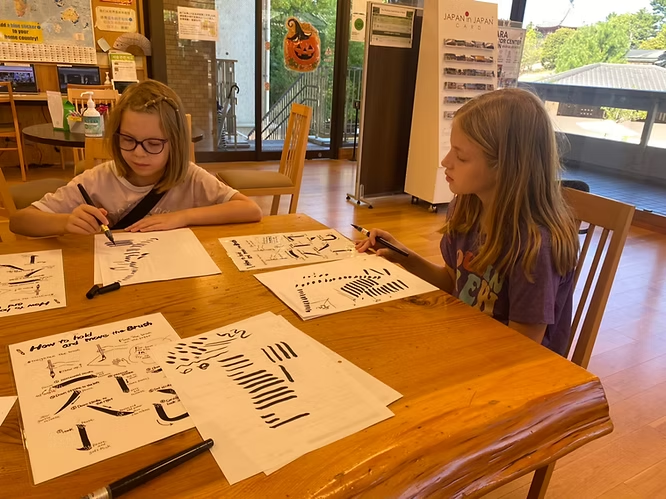
At Nara's Visitor Centre, a volunteer introduced the girls to the basics of kanji, explaining that while more than 50,000 characters exist, only about 2,400 are used regularly in everyday life.
Their first real encounter with Japanese writing had come even earlier at Sengaku-ji in Tokyo, where they carefully copied a sutra by hand to earn their first goshuin, long before they could read a single word of the script.
As we moved from country to country, they picked up greetings, numbers, and the occasional useful phrase in Japanese, Vietnamese, Thai, and Lao, only to forget much of it once we crossed the next border.
They were never going to become fluent in Japanese in 11 days, but seeing us make the effort encouraged them to do the same. What they gained was a growing comfort with not understanding everything, and the confidence that communication doesn't have to be perfect. Sometimes a smile or a gesture can go a surprisingly long way.
Since returning home, both girls have started learning French, and I've started learning Japanese. What began as a few greetings and phrases on the road has grown into a genuine interest in learning new languages.
9. Gratitude & Appreciation
We talked a lot during the trip about how lucky we were to be doing it. But just as importantly, it reminded us how much we value the life we have at home.

The one-night homestay at Living Land Farm was a good example. The girls loved the novelty of the mosquito nets and thatched hut, and getting to help plough a field with a buffalo, but it was also a reminder that what feels like an adventure to a visitor is everyday life for someone else.
Throughout parts of Southeast Asia, the girls saw poverty that simply doesn't exist in quite the same way at home, including children their own age selling souvenirs or asking tourists for money. Those encounters were often uncomfortable, but they also prompted conversations about opportunity, and how differently childhood can look depending on where you're born.
Another example came during our slow boat journey down the Mekong. We stopped at a small village near Pak Beng in Laos, and if I'm honest, I found the experience a little uncomfortable. Walking through someone else's community as a visitor felt intrusive, even though we were welcomed.
At the same time, tourism provides income for communities like these. What stuck with the girls most was the local school, where parts of the building were visibly falling into disrepair. Afterwards, we all wished we'd known in advance so we could have brought school supplies, books, or even just a football to leave behind.
More than anything, moments like that reminded us how much we have, and how easy it is to take it for granted.
10. Alternative Learning Methods
Worldschooling meant the girls experienced learning in ways a traditional classroom simply couldn't offer. They kept up with some formal schoolwork, like maths, but most of what they picked up became far more independent and self-directed.

Seeing, touching, and experiencing something firsthand made learning feel real in a way a textbook never could. We regularly asked the girls to write short essays about significant experiences from the trip, like our visit to the temples of Siem Reap, and just as importantly, they had to learn how to manage their own time to get the work done.
There was rarely a fixed schedule, only the expectation that the work would happen eventually. Deciding when and where to sit down and do it was entirely up to them, a skill we hope Jessica in particular carries with her as she starts junior high this year.
That same self-directed curiosity showed up during our stay in Koh Lanta, where we walked past local farmers tapping rubber trees every day. The girls' questions about what they were doing sent us down a rabbit hole of videos, including an excellent explainer by Maddy Moate, and research into how rubber is produced, something none of us had given much thought to before the trip.

It also showed up in a project assigned by Jessica's school. Her teacher asked her to put together a short video diary for each city we visited, and she used quiet afternoons, bus rides, and boat trips to edit her own footage in CapCut before sending it back to her class.
It gave her classmates a glimpse into places most had never heard of, while giving Jess a genuine reason to reflect on each stop rather than simply move through it. It also helped build her confidence speaking to a camera and sharing her experiences with others.

Final Thoughts
None of these are things you'll find on a report card. But months on, they're the things we notice most: how the girls talk to strangers, how they handle a bad day, how they think about people who live differently than they do.
Worldschooling was never meant to be about replacing the classroom. It was about giving the girls a different kind of education alongside it, one built from real situations rather than lesson plans.
It's also left them wanting more. Jess has already started asking about the Great Wall of China, and Evelyn has her sights set on Paris. If 100 days did nothing else, it proved the travel bug is well and truly caught.


Comments