.png)
5‑Day Kyoto Itinerary for First‑Time Visitors (kid‑Friendly Guide)

Updated: Sep 3

If Tokyo is all neon lights and futuristic energy, Kyoto is its more traditional counterpart, and is a beautiful mix of ancient temples, Japanese gardens, and historic streets.
It’s also incredibly family‑friendly, with plenty of hands‑on cultural experiences, wide temple grounds for kids to explore, and some of the most iconic scenery in all of Japan.
So, is five days enough for Kyoto? The honest answer is 'it depends'.
Kyoto has more than 1,600 temples and countless corners of the city to explore, so you can’t possibly see everything, however we found that five well‑planned days were enough to experience most of the city’s highlights at a kid‑friendly pace.
Those five days were part of 11 wonderful days travelling through Japan during our 100 days of travel across Asia, Australia, and New Zealand. Even after returning to Canada, Kyoto is still one of the most memorable cities from our entire journey.
This itinerary was part of our full 100-day family sabbatical, if you're planning something similar, see our complete guide to planning a round-the-world trip with kids.
This itinerary brings together Kyoto’s must‑see highlights through the lens of a real family trip. It's based on months of research, on‑the‑ground experience, and a few lessons learned the hard way, and is designed to help you explore Kyoto at a comfortable pace, organise sights logically, and enjoy the city without feeling rushed or overwhelmed.
Ready to start planning your Kyoto adventure? Let's jump in!
This post may contain affiliate links. If you click through and make a purchase, I may earn a small commission at no extra cost to you. We only ever share honest reviews of products and experiences we genuinely love.
5 Day Kyoto Itinerary at a Glance
Here’s a quick look at the main highlights for each day of the itinerary.
Table of Contents
Otagi Nenbutsu‑ji Temple
Saga‑Toriimoto Street
Adashino Nenbutsu‑ji Temple
Arashiyama Bamboo Forest
Tenryu-ji Temple
Katsura River walk & Togetsukyo Bridge
Iwatayama Monkey Park
Kinkaku‑ji (Golden Pavilion)
Ryoan-ji (Zen Temple)
Ninna-ji Temple
Nijo Castle
Nishiki Market
Yasaka Pagoda viewpoint
Kiyomizu‑dera Temple
Sannenzaka & Ninenzaka
Kodai‑ji
Ryozen Kannon
Maruyama Park & Yasaka Shrine
Daigo‑ji Temple Complex
Sanbō‑in Temple & gardens
Five‑storied pagoda
Benten‑dō Pond
Fushimi Inari Shrine
Ginkaku‑ji
Philosopher’s Path
Heian‑jingu Shrine
Nanzen‑ji Temple Complex
Nintendo Museum
Ninja Experience or Samurai Workshop
Japanese Cooking Class
Osaka & Osaka Castle
Nara (and the bowing deer)
Our Top Accommodation Pick
Best Time to Visit
How to Get Around
Spending More Time in Japan?
This itinerary covers Tokyo well on its own. But if you can stretch your trip out, our 2 Week Japan Itinerary builds on everything here and adds Tokyo, Nara, and Osaka to the mix, well worth a look if Japan is turning into more than just a Kyoto trip.
Read Our 2 Week Japan Itinerary here.

Kyoto Itinerary Google Map
Whenever we plan a trip, we always start with Google Maps. It helps us visualize locations and create efficient itineraries. We've added all the sights and attractions to the map below to help you see where everything is and plan your own itinerary.
To save the map to your Google Maps account, click the star next to the title. To access it later, open Google Maps, go to "Your Places," and find it under "Maps."
Day 1 - Arashiyama
Arashiyama is one of Kyoto’s most beautiful districts, with a wonderful mix of temples, cultural sites, peaceful riverside walks, well-preserved historic streets - and even a monkey park.
Many people make the mistake of coming here only for the Instagram‑famous bamboo forest, get swept up in the overwhelming crowds, and leave disappointed without seeing anything else that Arashiyama has to offer.
If you want more detail on the attractions in this area, our Arashiyama post outlines the best things to do and offers two suggested itineraries: an early‑riser version and a kid‑friendly version designed around a more relaxed pace.
With that in mind, here’s how we recommend spending your first full day in Kyoto in Arashiyama.
Otagi Nenbutsu‑ji Temple

Otagi Nenbutsu‑ji is a little outside central Arashiyama, so a short walk north, or a quick taxi ride makes it a great place to start your day. The temple opens at 9 a.m., so aim to get there right at opening.
The temple grounds are home to over 1,200 hand‑carved rakan statues, ranging from calm, prayerful figures to ones bursting with laughter.
Because it can get busy when tour groups arrive, starting here gives you a quieter experience, and it naturally leads into an Arashiyama route where you can walk downhill toward the preserved streets.
Before you leave, consider picking up a goshuin, which is a beautifully hand‑written temple seal that you can collect in a book called a goshuincho.
Saga‑Toriimoto Street Preserved Street

From Otagi Nenbutsu‑ji temple, you can walk into town along the beautiful Saga‑Toriimoto Street Preserved Street. The area is lined with traditional homes, some with thatched roofs, and offers a glimpse into what Kyoto looked like centuries ago.
Helpful tip: About halfway down, you’ll find a beautiful little coffee shop, and they even hand out free chocolates with your drink.
Adashino Nenbutsu‑ji Temple
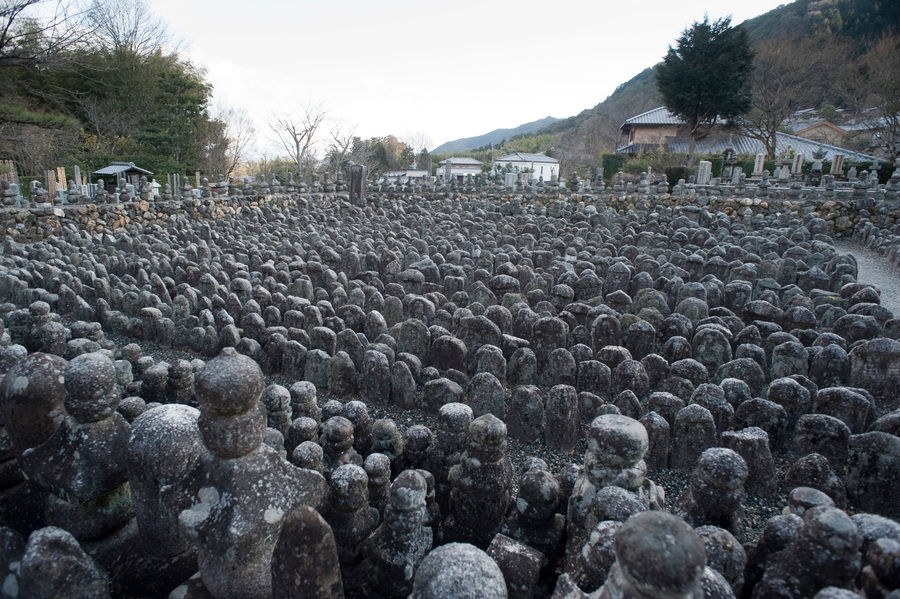
This temple is perhaps not as popular as some of the others in Arashiyama, but we think it absolutely deserves a spot in this itinerary.
Adashino Nenbutsu‑ji is a unique temple just off the Preserved Street, that is best known for the hundreds of stone statues that fill its grounds and that give it a striking, almost otherworldly atmosphere.
But the real highlight, and the main reason we recommend visiting is the quiet, relatively unknown bamboo grove within the grounds. It's not as large, but it offers a similar experience to the famous Arashiyama bamboo forest, but without the overwhelming crowds.
Tenryu‑ji Temple

Next up, we recommend visiting Tenryu‑ji, which is one of Kyoto’s most important Zen temples and a UNESCO World Heritage Site. It's located right beside the Bamboo Forest so it's an easy addition to most Arashiyama itineraries.
Itinerary planning tip: Visit Tenryu‑ji first, then continue through the Bamboo Forest and follow the path downhill toward the river for an easy, one‑way route.
The highlight here is the 14th‑century Sogenchi Pond Garden, an absolutely stunning example of landscape design and one of the finest surviving traditional Japanese stroll gardens.
Arashiyama Bamboo Forest

Beautiful? Absolutely. Peaceful? Not usually.
The famous Bamboo Forest is stunning, but it’s also one of the most crowded spots in Kyoto, especially from mid‑morning onwards. You’ll often see long lines of visitors in rental kimonos waiting to get that “I’m the only one here” photo.
If you’re looking for a peaceful experience here, you’ll need to arrive no later than 8 a.m., before the steady stream of tourists shows up.
My honest advice? Consider visiting the bamboo grove at Adashino Nenbutsu‑ji Temple (listed above) or the bamboo forest at Kodai‑ji Temple (Day 3 of this itinerary) instead. Both offer a similar bamboo‑grove atmosphere without the overwhelming crowds. You can then use the main Bamboo Forest simply as a scenic walkway down to the park, where the crowds finally begin to thin out.
Okochi Sanso Villa
At the far end of the Bamboo Forest, Okochi Sanso Villa is a great option if the crowds are getting a bit too much. The villa is set in the hills above the grove, and was once the estate of a famous Japanese silent‑film actor. It is now a beautifully maintained strolling garden.
There’s a small admission fee, which includes complimentary tea served in a traditional tea room overlooking the grounds - and honestly, the tea experience alone makes it worth the visit.
Arashiyama Park and Katsura River Walk

Arashiyama Park is located at the far end of the Bamboo Forest and is a lovely place to unwind after the crowds. Within minutes, the atmosphere shifts, the crowds dissipate, and you’re suddenly surrounded by nature.
Start by heading up to the main viewpoint for views over the valley and the Katsura River, then follow the path downhill past some old buildings toward the river.
Once you reach the Katsura River, the walk toward the iconic Togetsukyo Bridge is lovely, with boats drifting quietly along the water.

Togetsukyo Bridge

Togetsukyo Bridge is one of Arashiyama’s most recognisable landmarks, and crossing it is worth crossing at least once. It spans the Katsura River and is usually busy, but the views from the bridge (and from both ends) are well worth it. If you’re heading to the monkey park, you’ll cross it anyway.
Both sides of the bridge are lined with cafés and small eateries, making it an easy place to stop for lunch or a mid‑afternoon treat.
Iwatayama Monkey Park

One of our family’s highlights in Arashiyama was visiting Iwatayama Monkey Park. It’s located at the top of a steep but manageable 20–25 minute climb. The walk can be challenging in the heat, but there are benches along the way for breaks, and the effort is absolutely worth it.
At the top, you’ll find panoramic views over Kyoto and hundreds of monkeys roaming freely.

We were a bit unsure about how ethical the park would be, but we were pleasantly surprised by how the feeding is handled.
You can buy a small packet of peanuts or apple pieces, but feeding is only allowed from inside a hut, where you pass the food through the bars to the monkeys waiting outside.
It felt controlled and safe for children, and the monkeys clearly came and went as they pleased, which was reassuring to see.
Day 2 - Northern Kyoto & Central District
After a nature‑heavy first day in Arashiyama, today explores a different side of Kyoto: iconic temples, a feudal‑era castle, and the city’s most famous food market. It’s a full but very manageable day, especially if you start reasonably early and keep a steady pace.
We recommend tackling the northwest sights first, then finishing centrally in Nishiki Market, where you can eat, wander, and unwind at your own pace.
Kinkaku‑ji (Golden Pavilion)

Kinkaku‑ji is one of Kyoto’s most instantly recognisable landmarks, and while it’s undeniably busy, it’s a must-see.
The temple is covered in gold leaf and reflects beautifully in the surrounding pond. There is a walking route through the grounds, which is one‑way, so even during busy periods the crowds tend to keep moving. It took us around 90 minutes to get around the entire temple grounds at a 'family with kids' pace.
Planning Tip: Aim to arrive right at opening time, or as close to 9 a.m. as possible, before the crowds build.
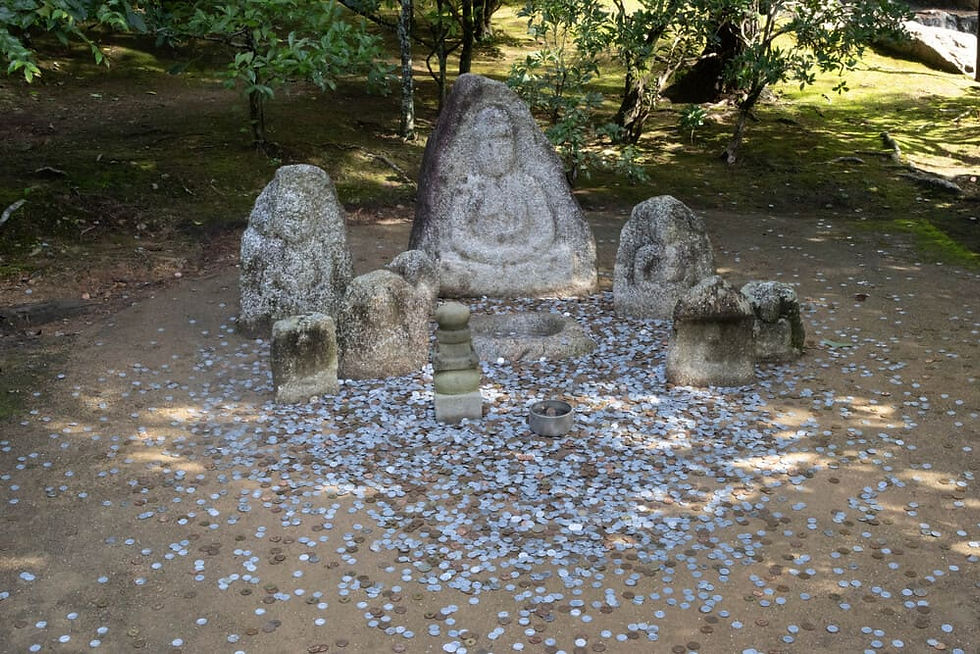
It's worth noting that there is no access inside the pavilion, but you do experience differing viewpoints as you walk through the grounds. There are also other things to see within the grounds, such as Anmintaku Pond, which is said to never dry up, and some statues where visitors can try tossing coins into a small stone basin, which our kids really enjoyed.
Ryoan‑ji Temple

A 20-minute walk or bus ride from Kinkaku‑ji brings you to Ryoan‑ji, which is home to one of Japan’s most famous Zen rock gardens.
Ryoan-ji temple is a very different experience from the spectacle (and crowds) of the Golden Pavilion, but equally fascinating.
The rock garden is intentionally sparse, with fifteen stones arranged on white gravel, that are meant to be viewed quietly, without explanation. From any angle, one stone always remains hidden, which is said to symbolise the idea that complete understanding is impossible.

After you have finished viewing the rock garden, it’s well worth continuing along the path that circles Kyōyōchi Pond, which is especially beautiful in autumn when the leaves turn red.
It might not be the most immediately engaging temple for children, but we felt it was an important stop for helping our girls better understand Japanese culture and the value placed on stillness, observation, and reflection.
Ninna-ji Temple

Haven’t quite scratched your temple itch yet?
While we didn’t visit it ourselves, Ninna‑ji is a great option if you’re looking to spend more time in northern Kyoto. It’s a much quieter temple and is only about a 15‑minute walk from Ryoan‑ji, making it easy to add to your day.
Highlights include a stunning gate at the entrance, an interesting pagoda tucked toward the back of the grounds, and peaceful gardens where you can sit and enjoy the scenery.
Nijo Castle

Quick Planning Note: Depending on your timing, you may choose to visit Nishiki Market first and grab lunch before heading to Nijo Castle. From a logistical perspective though, Nijo Castle makes the most sense as your first stop as you work your way back toward central Kyoto.
Nijo Castle was built as the residence of Tokugawa Ieyasu, the first shogun of the Edo period, and offers one of the clearest windows into Japan’s feudal past. Unlike many of Kyoto’s temples, it was designed as a seat of power rather than a place of worship, which gives the entire site a noticeably different atmosphere.
The standout experience is the interior of Ninomaru Palace, where you walk across the famous “nightingale floors” that chirp softly underfoot. These ingenious floors were deliberately engineered as an early warning system against intruders, which the girls found fascinating.
Inside, the palace’s lavish rooms are adorned with gold screens, painted tigers, and pine trees, all carefully chosen to project authority and control. One practical note: photography isn’t allowed inside the palace.

After touring the palace, take some time to wander the castle grounds. You’ll find several beautifully landscaped Japanese gardens, as well as the stone foundations of the former keep. You can climb up the stone steps up to the top for a view over the grounds, which helps you better appreciate the scale and layout of the castle complex and the moat that surrounds the castle.

Nishiki Market

A great way to finish your day is to take a wander through Nishiki Market, often referred to as “Kyoto’s kitchen,” which runs several blocks parallel to Shijo Street.
Nishiki is packed with food stalls, small shops, and centuries‑old vendors selling everything from local specialities and matcha sweets to fresh seafood and skewered delicacies.
A gentle reminder: while eating at stalls is acceptable, eating while walking is generally considered impolite in Japan. Instead, use the small standing areas provided outside many stalls for customers.
If you’re looking for something a little more formal to sit down to, we really enjoyed our meals at Teppanyaki & Okonomiyaki Zetto and A Happy Pancake, both of which are just a short walk from Nishiki Market.
Day 3 - Higashiyama & Gion District
Today is one of the most iconic days of this Kyoto itinerary. Southern Higashiyama brings together Kyoto's most famous temples, traditional streets, and historic neighbourhoods within a largely walkable area - though it makes for a long, full day of exploring, so be prepared!
This area does get busy, so of all the days on the itinerary, this is the one I recommend getting up early to avoid the crowds as much as possible.
Yasaka Pagoda (Hokan‑ji Temple)

We recommend starting your day with a walk through the old streets leading up to Yasaka Pagoda, one of Kyoto’s most iconic pagodas and a defining landmark of Higashiyama.
The five‑storey pagoda is one of Kyoto’s most recognisable symbols, and seeing it up close, framed by traditional wooden houses and narrow streets, is pretty amazing. It gets really busy so the earlier the better!
From here, it’s an easy walk toward Kiyomizu‑dera, where you'll pass through some of the area’s most photogenic old streets, traditional shops and cafes along the way.
Kiyomizu‑dera Temple

Next up is Kiyomizu‑dera, which is one of Kyoto’s most famous temples, and despite the crowds, it absolutely needs to be on any Kyoto itinerary. You can see in the photo above just how busy it gets!
The main hall’s enormous wooden stage juts out over the hillside and offers sweeping views across the valley. From the lookout, it almost feels like you’re in the countryside rather than one of the most densely populated areas of Kyoto!

During our visit we learned that the entire structure was built without the use of nails, which is pretty mind blowing considering its scale.
Once you’ve finished exploring the temple and hall complex, be sure to take the path to the famous viewpoint, where you can see the main hall jutting out from the hillside, framed by the mountains in the background. Here is the location on Google Maps.
Sannenzaka & Ninenzaka

After Kiyomizu‑dera, follow the path downhill into Sannenzaka and Ninenzaka, two of Kyoto’s most atmospheric and lively streets. You may have already passed through parts of this area on the way up to the temple, but by following Google Maps you can weave through quieter side streets and escape some of the crowds.
These narrow streets can be busy, but they have a definite charm. We stumbled across some great small gift shops, and our girls found a few lovely presents for friends back home.
Food recommendation: It might not be the most traditional dish to try in Kyoto, but the apple pie slice we had at Apple Pie Lab was honestly one of the best things we ate in the city.
Ryozen Kannon

Once you’ve explored Ninenzaka and Kiyomizu‑dera, continue toward a calmer stretch of Higashiyama lined with smaller temples. Ishibe Koji leads you away from the busiest areas and into the more relaxed surroundings of Maruyama Park.
The first temple you’ll arrive at is Ryozen Kannon. While it’s a relatively modern temple, it’s still very impressive. The enormous statue of Kannon, the goddess of mercy, serves as a memorial to the “unknown soldiers" that lost their lives during World War II.
As we entered, we were offered incense to place in the burner in front of the statue, a small ritual that our girls always enjoyed taking part in.
Kodai‑ji Temple & Small Bamboo Grove
Just a five‑minute walk further along the road brings you to Kōdai‑ji, another beautiful Zen temple known for its carefully manicured Japanese gardens. The grounds feature several distinct garden styles, including a dry rock garden viewed from the main hall and a strolling pond garden with a small bridge you can cross for a closer look.
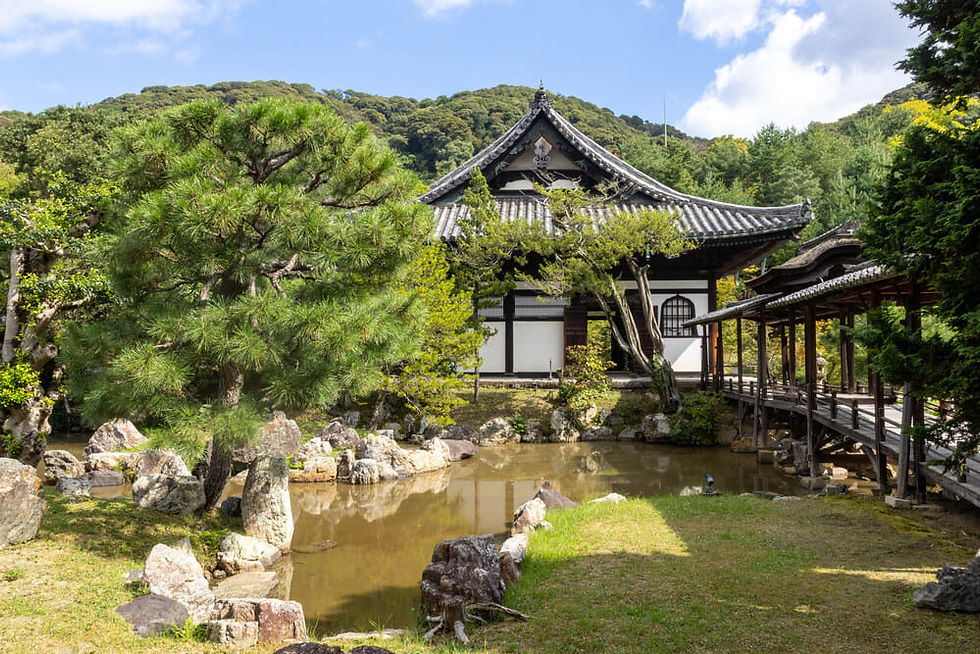
The grounds also include a small bamboo grove, which was so much calmer than the one we visited in Arashiyama, along with two historic tea houses that looked nice (although we didn't go in).

Maruyama Park & Yasaka Shrine

After putting in plenty of steps in the morning, Maruyama Park is a welcome place to slow down and take a breather.
There are several lovely, photogenic spots throughout the park, including the small arched bridge shown above, and in April it becomes one of the busiest places in Kyoto for cherry blossom viewing parties.
At the edge of the park sits Yasaka Shrine, also known as Gion Shrine, one of the most famous shrines in Kyoto. The entrance is marked by a tall, imposing vermilion torii gate that’s hard to miss and a striking example of Japan’s traditional architecture.

Day 4 - Daigo‑ji & Fushimi Inari
Day four pairs one of Kyoto’s quietest, most spacious temple complexes with one of its most famous and busiest shrines. It’s a great example of how varied Kyoto can be in a single day, and works best with a calm, unhurried morning followed by a late‑afternoon visit to Fushimi Inari.
Daigo‑ji Temple Complex
Daigo‑ji is located in southeastern Kyoto and is a vast UNESCO World Heritage Site made up of multiple temple halls, sub‑temples, gardens, and pagodas. It feels far removed from the busier parts of the city, and despite its historical significance, it is surprisingly quiet.
Over the few hours we spent there, we could probably count the number of other visitors on two hands. It really was that quiet.
For the full story on Daigo-ji's history, the Reihōkan treasure hall, and everything else worth knowing before you go, we've written a complete guide here.
The grounds are extensive and easy to walk, with wide paths linking the halls, gardens, and pagodas, so great for families with kids.
Sanbō‑in Temple & Gardens

Within the Daigo‑ji complex, Sanbō‑in is a temple known for its beautifully preserved interiors and stunningly landscaped gardens, which are designed to be viewed from inside the building.

Sanbō‑in is one of the few temples where we were allowed to sit on tatami mats inside the rooms, with the garden beautifully framed as you look out. If you enjoy temple interiors as much as outdoor spaces, this was one of our most rewarding interior visits in Kyoto.
Five‑Storey Pagoda
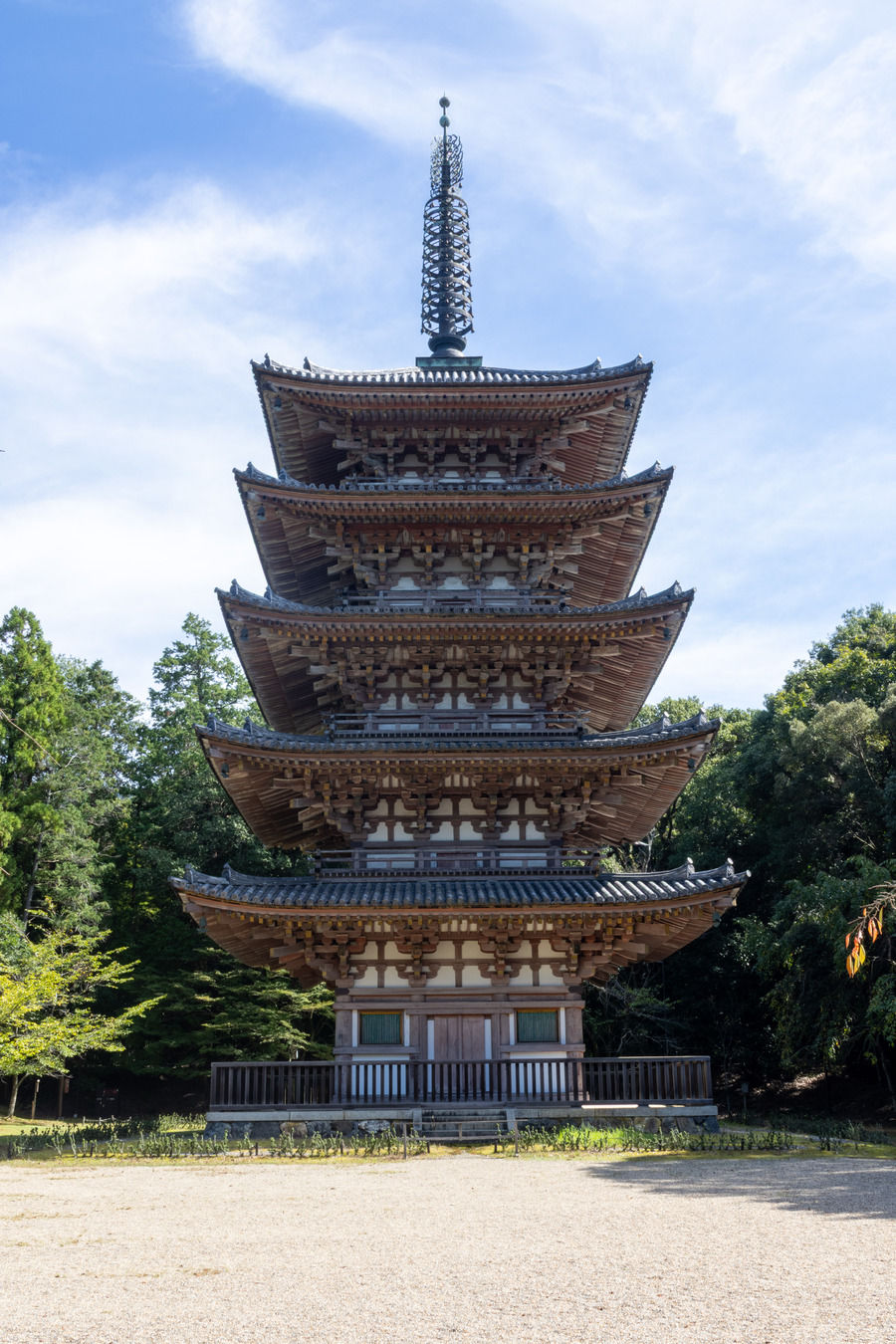
The Daigo‑ji complex is also home to an extraordinary five‑storey pagoda that dates back more than 1,070 years. In fact, it is widely regarded as the oldest surviving wooden building in Kyoto, and standing beside it really puts that history into perspective.
Benten‑dō Pond

A short walk from the pagoda brings you to one of the most atmospheric spots within the Daigo‑ji complex: Benten‑dō Pond. While the temple itself is fairly modest, the setting is what makes this area special. The red bridge, still water, and koi gliding through the pond combine to create a scene that feels like a quintessential Japanese postcard.
In autumn, when the leaves turn vibrant shades of red, this becomes one of the most popular photography spots in Kyoto.
Fushimi Inari Taisha

In the late afternoon, make your way to Fushimi Inari Taisha, ideally after 5 p.m. to help avoid peak crowds. Even at this time, the lower section of the shrine can still be very busy.
The famous orange torii gates are pretty unforgettable, but the lower paths can feel overwhelmingly crowded. As you continue uphill though, the atmosphere changes, the crowds become thinner, and things do start to calm down a bit.
Along the way, you’ll pass small sub‑shrines, stone lanterns, and quiet junctions where side paths branch off into the forest. There are also occasional rest spots, and even a few vending machines in case you get thirsty!

As daylight fades, the shrine takes on a very different feel. Walking beneath the softly lit torii gates creates a moody atmosphere that feels completely different from the daytime experience.
That said, if you’re travelling with very young children, they might find the darkness a little scary (as it is quite dimly lit), so bear that in mind. For us, visiting in the early evening felt atmospheric rather than uncomfortable, and we were glad to experience Fushimi Inari both in daylight and after dark, as each offered something quite different.
Day 5 - Eastern Kyoto
For our final day in this itinerary, we are going to explore a quieter, more contemplative side of Kyoto. The sights are spaced along a logical walking route in the city’s eastern neighbourhoods and lend themselves to a slower pace than some of the busier days earlier in the itinerary.
Ginkaku‑ji (Silver Pavilion)

Start your day at Ginkaku‑ji, also known as the Silver Pavilion, one of Kyoto’s most important temples and a fitting counterpart to the Golden Pavilion visited earlier in the trip. Despite the name, it’s not covered in silver leaf; instead, the beauty here is subtle and restrained rather than lavish or showy.
The temple grounds are centred around a carefully raked sand garden and moss‑covered landscape, which reflects the more restrained aesthetic this part of Kyoto is known for.
There is also a short walking path that loops through the garden and gradually climbs the hillside, with a nice view back across the grounds and out toward the city.
While Ginkaku‑ji does attract visitors, the route through the gardens keeps people moving, and arriving earlier in the day helps maintain a more relaxed atmosphere.
Philosopher’s Path

Just a short walk from Ginkaku‑ji is the start of the Philosopher’s Path, one of Kyoto’s most popular walking routes. The path runs for around 2 kilometres, linking Ginkaku‑ji with the area just north of Nanzen‑ji, and follows a narrow canal through a mix of residential streets and small temple grounds.
The route is picturesque, with the gently curving path running alongside the waterway, which is lined with hundreds of cherry trees. In early April, these burst into bloom, turning the Philosopher’s Path into one of Kyoto’s most popular hanami spots.
Outside cherry blossom season, it’s far quieter and makes for an easy, stress‑free way to walk between two of Kyoto’s most famous temples without relying on public transport. Walking the full length takes around 30–45 minutes at a steady pace, or closer to an hour if you stop along the way.
Heian‑jingu Shrine

While slightly off the Philosopher’s Path, a short walk west takes you to Heian‑jingu Shrine, another striking example of Japanese architecture. The massive vermilion torii gate and ornate shrine roof immediately stand out and give the whole place a grand, ceremonial feel.
A short visit here is more than enough, and because it’s only around a 15‑minute walk off the route, it’s easy to add into the day without much effort or backtracking.
Nanzen‑ji Temple Complex

The final temple of the day is Nanzen‑ji, which is another of Kyoto’s important Zen temple complexes and an excellent way to round out the day.
One of Nanzen‑ji’s most recognisable features is the brick aqueduct running through the temple grounds, which is an unexpected piece of Meiji‑era infrastructure that adds architectural interest and a layer of history you don’t often see at Kyoto temples.

Fun Kid-Friendly Activities
If you have additional time in Kyoto, or feel like changing up part of the itinerary, there are several fun kid-friendly experiences that can be easily added. They work particularly well for families and are a great way to balance Kyoto’s temples with activities that offer a change of pace.
Here are some suggestions:
Nintendo Museum (Uji)

For something completely different, consider visiting the Nintendo Museum in Uji, located just south of Kyoto. This is a great option if you’re travelling with older kids or teens, or if Nintendo nostalgia plays a big role in your household.
The museum focuses on Nintendo’s long history, from its early days producing playing cards through to modern consoles.
That said, getting tickets is not straightforward (to say the least).
Entry is capped, demand is huge, and the booking system catches a lot of people out. We missed out ourselves, which sent us down a deep rabbit hole of research to figure out exactly how it all works and how people are actually securing tickets.
Ninja Experience or Samurai Workshop
If your temple days start to blend together, a ninja or samurai experience can be a fun way to switch things up. Kyoto has several family‑friendly workshops that offer hands‑on activities like throwing shuriken, learning basic sword movements, or dressing in traditional attire.
These experiences are typically short (around one to two hours), making them easy to slot into an afternoon or combine with sightseeing elsewhere in the city.
The most popular experiences are at the Samurai Museum.
Japanese Cooking Class

A hands‑on cooking class is a great way to add something different to a Kyoto itinerary, especially if you’re looking for a break from sightseeing-heavy days. Cooking classes typically focus on classic Japanese dishes such as sushi, tempura, ramen, or bento‑style meals, and many are designed to accommodate kids.
Most classes run for two to three hours and are held in small groups, making them easy to fit into a half‑day. When travelling with kids, it’s especially important to choose a class with clear English instruction, and the best options tend to sell out well in advance, which is why we recommend booking through a reliable platform like Klook.
That said, if you’re trying to decide whether to do a cooking class in Kyoto or Tokyo, we’d honestly recommend the class we did in Tokyo without hesitation, as it was hands down one of the best things we did on our entire trip.
Easy Day Trips from Kyoto
Kyoto also makes an excellent base for day trips, with several destinations reachable in under an hour by train. These trips work well if you want to see a different side of the Kansai region without changing hotels.
Osaka Day Trip & Osaka Castle
Osaka is an easy day trip, as it is reachable in around 30–45 minutes from Kyoto. The city offers a faster‑paced, food‑focused contrast to Kyoto’s traditional atmosphere.
A great starting point is Osaka Castle, one of the most iconic and visually striking landmarks in Japan. The views as you approach are impressive, and the castle itself is just as striking up close.
Once inside the castle grounds (which are free to enter), you’ll find a fantastic viewpoint overlooking a Japanese garden and pond in the foreground, with the castle rising dramatically in the background - a classic and memorable Osaka scene.

Many people pair the castle with areas like Dōtonbori for street food and neon‑lit night walks, which is part of what makes Osaka such an appealing, high‑energy city to explore.
If you’d prefer to stay in Osaka, we highly recommend the Osaka Station Hotel. It’s definitely a splurge, but it was one of the best hotels we stayed in on our entire trip, and the location is excellent.
Day Trip to Nara
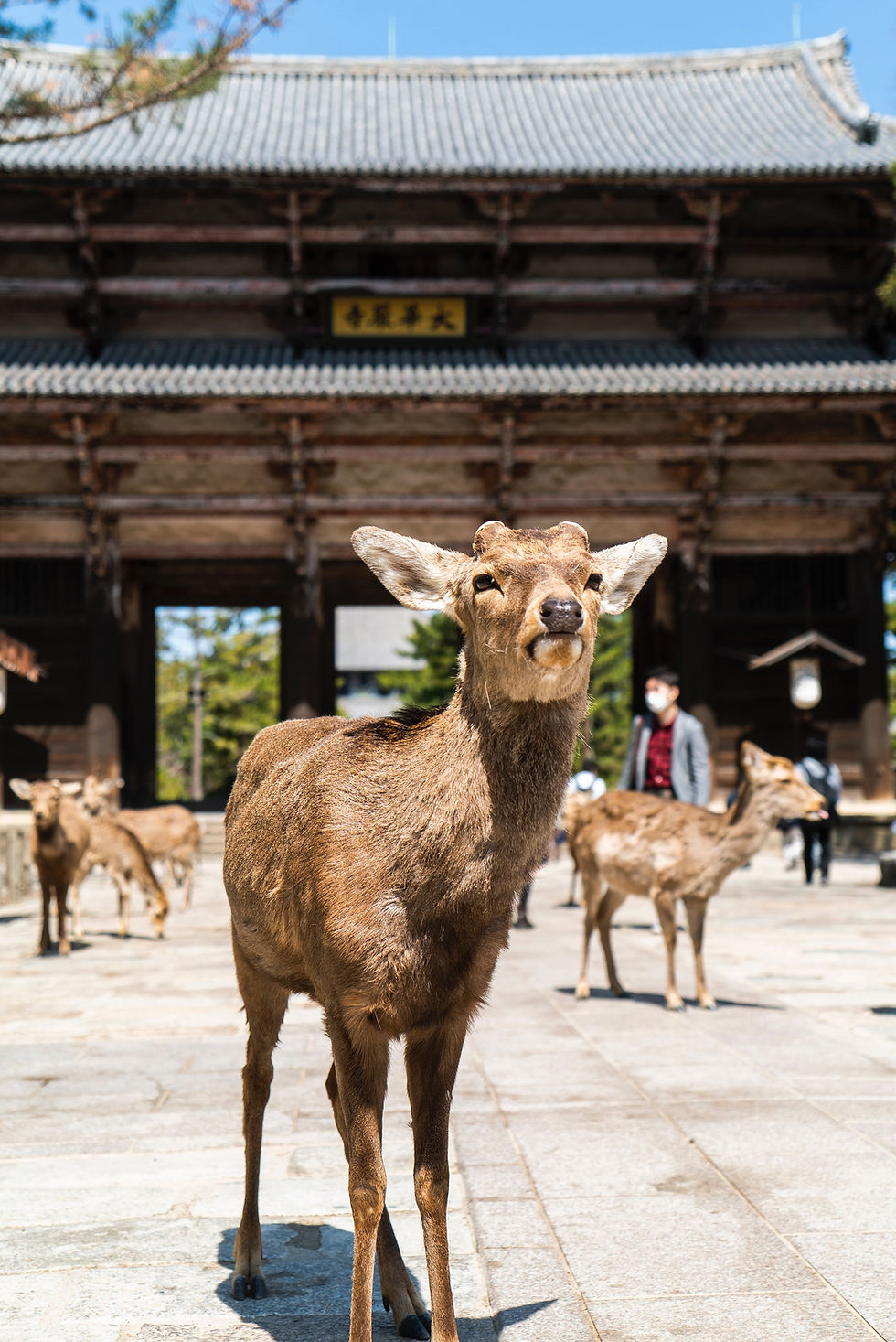
One of the most popular and easiest day trips from Kyoto is Nara, which is less than an hour away by train. Nara is best known for its large park, tame (and occasionally aggressive) free‑roaming deer, and several important historic sites.
A quick word of warning: while the deer are a major draw, they can be surprisingly assertive, especially around food. We learned this the hard way when Jess was head‑butted by one, so it’s important to keep a close eye on kids and be cautious when feeding them.
The main historical highlight is Tōdai‑ji Temple, home to the Great Buddha. Even if you’ve already visited several large temples in Kyoto, this one still feels impressive thanks to its scale and setting.

Overall, Nara is a great option for families, as the open park spaces and novelty of the deer help keep kids engaged while still offering meaningful cultural sights.
We've written a full Nara Park day trip guide if you want the complete breakdown of what to see and a suggested itinerary.
Our Top Accommodation Pick
We stayed at the DoubleTree by Hilton Kyoto Higashiyama and found it to be a great choice for families. The rooms were surprisingly spacious by Kyoto standards, the service was excellent, and the biggest advantage by far was the location.
It’s around a 15‑minute walk to Ninenzaka and the Higashiyama sightseeing area, making it easy to explore some of Kyoto’s most atmospheric streets on foot.
The hotel is also very well connected to Kyoto’s transport network. Kiyomizu‑Gojo Station is directly across the road, and there are several bus stops nearby. We even caught the bus to Daigo‑ji from right outside the hotel, which made getting around with kids incredibly straightforward.
We’ve written a full review of our stay here if you’d like to dive deeper into why it worked so well for our family.
When is the Best Time to Visit Kyoto?
The best time to visit Kyoto depends on what you’re hoping to experience, but in general spring and autumn offer the most comfortable weather and the city at its most scenic. Because so much of Kyoto’s appeal centres around outdoor sightseeing such as temples, gardens, and walking routes, the seasons tend to have a bigger impact here than in larger cities like Tokyo.
March to May (Spring)
Spring is one of the most popular times to visit Kyoto, largely due to cherry blossom season. From late March through early April, temple grounds, parks, and walking routes are transformed by pink blooms, creating some of the city’s most iconic views.
This short peak period comes with trade‑offs. Crowds can be intense at major sights, accommodation prices rise, and popular areas fill up quickly from mid‑morning onwards. Even so, cherry blossom season remains high on many people’s bucket lists - and it’s something we’d love to experience one day.
September to November (Autumn)
Our recommended time to visit Kyoto.
Autumn brings cooler temperatures, lower humidity, and increasingly dramatic scenery as the leaves change colour, particularly in late October and November. Many temples and gardens feature vivid autumn foliage, and the colours tend to last longer than cherry blossoms, spreading crowds out over several weeks.
Compared with spring, the pace in autumn often feels more manageable, making it one of the best times to combine comfortable weather with a calmer sightseeing experience. Try to avoid early October, when travel related to Chinese Golden Week can noticeably increase visitor numbers.
June to August (Summer)
Kyoto summers are hot and humid, and the heat can feel more intense here than in some other parts of Japan due to the city’s geography and the amount of walking involved in sightseeing.
If visiting during summer, especially with kids, it’s important to plan lighter days, start early, and build in frequent breaks. Taxis and public transport can help reduce time spent walking during the hottest part of the day.
On the upside, summer brings festivals and events that add energy to the city, and crowds at major temples are often thinner outside national holiday periods. If you’re comfortable with the heat, summer can still be rewarding with the right pacing.
December to February (Winter)
Winter is the quietest season in Kyoto, and a good option if avoiding crowds is a priority. Days are often cold but clear, and popular temples feel far more peaceful than at other times of year.
While the scenery is less colourful, occasional snowfall can be magical, especially around temples and gardens.
Winter also tends to bring lower accommodation prices, making it an appealing option for budget‑conscious travellers.
Avoid Major Holidays
If your dates are flexible, it’s worth avoiding Japan’s major travel periods, as Kyoto is one of the country’s most popular destinations and fills up quickly during these times:
Golden Week (late April to early May)
Obon (mid‑August)
New Year (late December to early January)
Chinese Golden Week (early October)
During these periods, crowds at key temples can be significantly heavier, and transport and accommodation are often busier and more expensive.
How to Get Around Kyoto
Kyoto’s transportation system isn’t quite as vast as Tokyo’s, but it’s still very easy to navigate once you understand how the city is laid out. Unlike Tokyo, where trains dominate, getting around Kyoto often involves a mix of walking, buses, trains, and taxis, depending on where you’re going.
Because many of Kyoto’s highlights are clustered by district, you’ll often find yourself spending most of the day on foot once you’ve reached the right area.
Using an IC Card in Kyoto (Suica, ICOCA, etc.)

An IC card is still your best friend in Kyoto. Whether you’re using Suica, ICOCA, or another regional IC card, they all work interchangeably on Kyoto’s trains, subways, and buses, as well as in convenience stores.
We used mobile Suica on our phones, which worked really well, and purchased physical cards for the kids, carried in lanyards. This made hopping on and off buses and trains stress‑free and avoided frantic card‑searching at ticket gates.
If you don’t already have an IC card, ICOCA cards are the local equivalent and are easy to pick up at major stations or airports.
Trains & Subways in Kyoto
Kyoto has far fewer train and subway lines than Tokyo, which actually makes things simpler. Most visitors use:
JR lines for longer connections and day trips
Kyoto Subway for north‑south or east‑west travel
Private railways for areas like Arashiyama
Your IC card works across all of these.
As in Tokyo, Google Maps is essential. It tells you which line to use, where to walk, which platform to stand on, and often which exit to take, which is incredibly helpful in larger stations like Kyoto Station.
Download offline maps before arriving, especially if you plan to rely on your phone for navigation throughout the day.
Buses in Kyoto
Kyoto’s bus network is extensive and covers many areas that trains don’t reach, especially temple districts. That said, buses can be slower than trains, particularly during peak tourist seasons or rush hour.
IC cards work on buses, and you usually tap when boarding and again when exiting. Routes and stops are clearly marked, but buses can become very crowded. When this happens, it can be difficult to move toward the exit in time - we missed our stop once simply because the bus was so packed we couldn’t physically get off.
Do I Need a JR Pass for Kyoto?

For most Kyoto‑focused itineraries, you do not need a JR Pass.
If you’re mainly travelling within Kyoto or making only one longer journey (for example, a single Shinkansen trip to or from another city), an IC card plus individual tickets is usually cheaper and more flexible.
A JR Pass starts to make sense if you’re planning multiple intercity trips within a short time frame, such as combining Kyoto with Osaka, Hiroshima, and Tokyo by Shinkansen. Even then, it’s worth running the numbers carefully, as the price has increased significantly in recent years.
It’s also worth remembering that the JR Pass doesn’t cover Kyoto’s subways, buses, or private railways, so an IC card is still required regardless.
Taxis in Kyoto
Taxis play a much bigger role in Kyoto than they do in Tokyo, especially with kids.
Because the city is spread out and many temple areas aren’t directly connected by train, taxis can be a huge time‑saver. They’re clean, safe, and reliable, and for short trips the cost is often reasonable.
When travelling as a family, we found that a taxi was sometimes only marginally more expensive than buying multiple bus or train tickets, and far easier when everyone was tired or the weather was hot.
Apps like GO work well in Kyoto, but street‑hailing taxis is also common near major stations and tourist areas.
Walking (A Lot of It)
Kyoto is a very walkable city, and walking is often the most enjoyable way to explore its historic districts. Areas like Arashiyama, Higashiyama, and around the Philosopher’s Path are best experienced slowly and on foot.
That said, the walking really adds up.
Temple grounds are large, walking routes between sights are longer than they look on a map, and it’s common to clock 20,000+ steps in a day without realising it. In summer, this can feel especially intense.
Comfortable shoes are essential, and planning realistic daily distances makes a big difference - especially when travelling with kids.

Our Other Japan Content
Are you interested in reading our other Japanese content?
We recommend starting here and browsing our daily diaries from Japan and the rest of our trip.
We also have a 5 day Tokyo itinerary - if you liked this post take a read of that for ideas.
Tokyo Specific:
Kyoto Specific:
Kid-Friendly Activities:
Food Related:
Accommodation Recommendations:


Comments