.png)
The Best Things to Do in Arashiyama, Kyoto: A Perfect One‑Day Itinerary

Updated: Aug 17
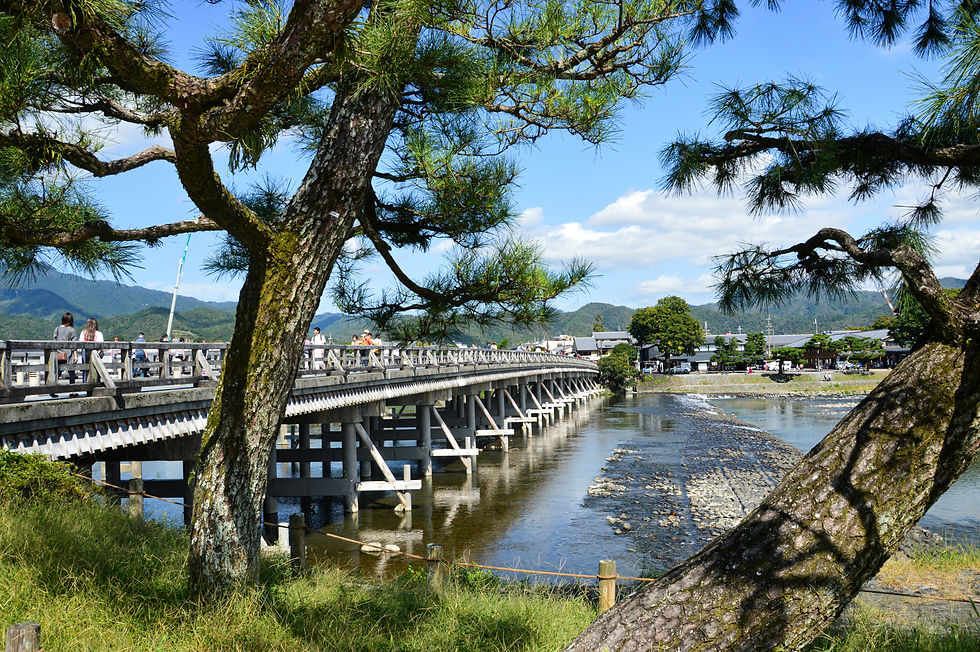
Arashiyama sits on the western edge of Kyoto and is one of the city’s most popular districts for visitors. People come for the famous bamboo forest, historically preserved streets, Zen temples, the monkey park, and the iconic Togetsukyo Bridge that crosses the Katsura River.
Although there is more than enough to fill two full days, most travellers visit on a single‑day trip since Arashiyama is a little removed from central Kyoto. That makes a focused one‑day itinerary a smart and efficient way to see the highlights without feeling rushed.
This guide combines what we personally did in Arashiyama with practical advice, including family friendly tips, detailed Google Maps, and our honest take on what’s truly worth your time versus what looks better on paper than in person.
At the end, you will find some one‑day model itineraries that tie everything together, so you can focus on the experience rather than the planning. We also include optional extras if you want to get off the beaten path a bit, prefer to extend your day, or even turn your visit into two days.
If you are looking for a full Kyoto itinerary, we that here too.
In this post, we’ll cover:
With all that in mind, here are the top things to do in Arashiyama.
This post may contain affiliate links. If you click through and make a purchase, I may earn a small commission at no extra cost to you. We only ever share honest reviews of products and experiences we genuinely love.
Map of Things to do in Arashiyama
Whenever we plan a trip, we always start with Google Maps because it helps us visualise the area and build an efficient route. To make your planning easier, we’ve pinned all of the top things to do in Arashiyama onto the map below so you can quickly see where everything is and create your own itinerary.
To use the map, click the tab in the top left corner to switch between layers and see more details for each location. To save it to your Google Maps account, click the star next to the title. You can access it later by opening Google Maps, going to “Your Places,” and looking under “Maps.”
The Best Things to do in Arashiyama
Arashiyama Bamboo Forest

The Arashiyama Bamboo Forest is easily the most famous sight in the district and one of the most photographed places in Kyoto.
Even if you’ve seen it in countless pictures, nothing quite prepares you for the height of the bamboo when you walk through it in person.
However, because it’s so well known, the forest is almost always busy.
In today’s Instagram‑driven world, a lot of people are focused on getting the “I’m the only person here” shot, which makes the whole experience a little more stressful than it needs to be, or at least it did for us.
If avoiding the crowds is important to you, then be prepared to arrive around 7 am. If you arrive after 9 am expect a bit of a free‑for‑all.
Another option is to take a rickshaw, as they travel along a designated route that regular visitors are not permitted to use. It's best to book ahead as they were very busy when we visited.
This isn’t me telling you not to go, just to adjust your expectations. Go at a time that works for you and appreciate it for what it is, crowds and all.
Tenryu‑ji Temple

Tenryu‑ji is one of Kyoto’s most important Zen temples, and it plays a significant role in the country’s religious and cultural history. It was one of our favourite temples in Kyoto.
Its main draw is the garden, which dates back to the 14th century which is widely considered one of the finest surviving examples of a traditional Japanese stroll garden. It’s no surprise that Tenryu‑ji is listed as one of Kyoto’s UNESCO World Heritage Sites.

At the heart of the garden is Sogenchi Pond. It’s beautifully designed, with rocks, plants, and trees placed so naturally that everything feels exactly where it should be.
It's an easy temple to include within your itinerary, as it is located right next to the bamboo forest.
Okochi Sanso Villa

If you’ve made your way through the bamboo forest and found it all a bit too busy or overwhelming, Okochi Sanso Villa is a lovely place to slow things down, as the crowds are noticeably less.
The villa was once the estate of a famous Japanese silent film actor, and it lies in the hills above the bamboo grove. Today, it’s essentially a beautiful strolling garden.
There is a small admission fee, but it’s only a few dollars and includes complimentary tea served in a traditional tea room overlooking the grounds.
Otagi Nenbutsu‑ji Temple

Otagi Nenbutsu‑ji is one of the most memorable stops in Arashiyama and definitely worth the trip, especially if you are travelling with kids.
The temple is known for its collection of more than a thousand rakan statues, each one carved by a different local artisan. The result is a wonderful mix of expressions on the figures, and the girls had a great time wandering around and choosing their favourites.
It’s actually a relatively new temple in its current form. All of the rakan statues were carved in the 1980s by everyday people under the guidance of a local priest and sculptor.
They’ve all grown a thick layer of moss now, so you’d never guess how new they are. They look like they’ve been standing there for hundreds of years.
Most people either taxi or bus up to Otagi and then walk back into town. From the temple gates, the path naturally leads onto Saga Toriimoto Preserved Street, and from there you can continue straight to Adashino Nenbutsu‑ji before carrying on into the main part of Arashiyama.
Saga Toriimoto Preserved Street

Saga Toriimoto is a lovely preserved street that captures the look and feel of old Japan, as it has many traditional wooden houses and several thatched‑roof buildings that give it a real village atmosphere.
Its just a short walk outside the centre of Arashiyama, but if you’re visiting Otagi Nenbutsu‑ji, the walk back into town naturally follows Saga Toriimoto Preserved Street.
Along the street you’ll find a few small coffee shops, craft stores, and even a temple offering really unique goshuin if you’re collecting them. Just note that most shops close by 5 pm, so it’s best to visit earlier in the day.
Adashino Nenbutsu‑ji Temple
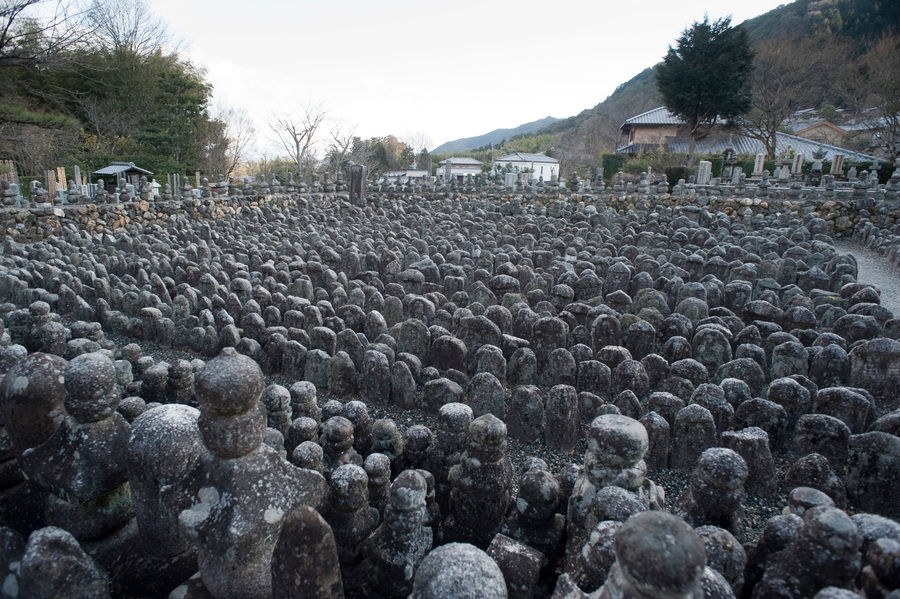
Adashino Nenbutsu‑ji is a unique temple at the northern end of the Saga Toriimoto Preserved Street, and it has a completely different feel from most of the temples in Arashiyama, and even Kyoto as a whole.
The temple is best known for the hundreds of stone statues that fill the grounds, giving it a very distinct look. Its origins go back to the 9th century, when stone figures were placed here as a way of memorialising the dead.
Over time, more and more statues have been gathered on the site, creating the collection you see today.
Arashiyama Park

Arashiyama Park is located at the end of the bamboo forest and is a lovely, quiet place to wander after the craziness of the bamboo forest. It’s amazing how quickly the atmosphere changes.
Within five minutes of entering the park, the crowds disappear, and you’re suddenly surrounded by quiet paths and views down toward the Katsura River. For us, this was one of the calmest parts of Arashiyama and one of our favourite parts of the day.
Start by heading up to the viewpoint, where you’ll get great views over the river valley. From there, the path winds down past some old buildings, as well as a beautiful historic restaurant that specializes in tofu, but you have to book well in advance so unfortunately, we couldn't get a reservation on the day we visited.
Yusai-tei Gallery
Just before you reach the river, you’ll come across the Yusai‑Tei Gallery, which is pretty unique art gallery as it uses the surrounding scenery as part of the artwork itself.
The building has large windows that frame the trees outside, and water features inside that when the light hits the water, the reflections create some stunning visuals.
We didn’t go inside as children have to be 12 years or older to enter, but it’s definitely on our list for next time when the kids are older.
Katsura River Walk

Once you reach the riverbank below Arashiyama Park, walking along the bank of the Katsura River is a lovely, easy stroll toward the famous Togetsukyo Bridge. The closer you get to the bridge, the busier it becomes, with little coffee shops and small gift stores along the path.
You’ll likely see boats passing by as you walk, and if you’re in the mood, you can even hop on one for a relaxing ride along the river.

Togetsukyo Bridge

Togetsukyo Bridge is one of the most recognisable sights in Arashiyama, and no visit feels complete without crossing it at least once.
The bridge stretches across the Katsura River, and although it’s usually quite busy, the views from on the bridge, and from either end, are incredibly scenic.
Despite appearances, the bridge itself was built using reinforced concrete, but its exterior was designed to look wooden, so it blends in with the scenery.
If you’re planning on going to the monkey park, you’ll naturally have to cross the bridge to get there anyway, but even if you aren’t, it’s worth walking across. The far side of the bridge has some great little cafés, mochi shops, and sweet snack stands, so worth exploring before you had back into town.
By the way, if you’re planning on grabbing some lunch here, be sure to check out our top 30 kid‑friendly food recommendations to try in Japan, as well as our fun and unique food experiences to try when visiting Japan.
Iwatayama Monkey Park

One of our favourite experiences in Arashiyama was our visit to Iwatayama Monkey Park, which is located at the top of a steady hillside climb overlooking the district.
We went without knowing exactly what to expect, and we had a few concerns about whether the park would feel ethical. Japan (and most parts of Asia in general) can be hit‑and‑miss on that front, but we were pleasantly surprised.
The walk up is a steep but steady climb, and in the heat, you will probably need a few stops along the way. There is no other option but to walk! There are benches along the path but be sure to take lots of water with you, it's tough in the heat.
At the top, there are dozens of Japanese macaques lazing around, grooming each other, chasing one another, and generally doing their own thing.
One of the things we liked most about this park is the way feeding is handled.
You can buy a small packet of peanuts or apple pieces, but you can only feed the monkeys from inside a hut, passing the food through the bars to the monkeys waiting outside. It feels controlled and safe for children, and the monkeys clearly come and go as they please.
At the summit, there are some amazing views over Kyoto, which would honestly be worth the effort on its own.

Kimono Forest

The Kimono Forest is a small but fun spot near the Randen tram station, where tall cylinders wrapped in colourful kimono fabrics line the pathways.
It doesn’t take long to visit, and I wouldn’t go out of my way to see it on its own, but if you’re catching the train to or from Arashiyama, it’s perfect for a quick photo.
Arashiyama Experiences for Families
If you want to make your day in Arashiyama a little extra special, or if you have the time to stretch your visit into two days, why not consider adding one of these experiences?
Sagano Scenic River Railway

The Sagano Scenic Railway, often called the Sagano Romantic Train, is a slow‑moving sightseeing train that runs between Arashiyama and Kameoka. The ride takes about 25 minutes and follows the Hozu River through a narrow valley, giving you plenty of time to enjoy the views of the water, cliffs, and forest around you.
You’ll see cherry blossoms in spring, deep green foliage in summer, red maple leaves in autumn, and the chance of snow in winter.
Most people ride the train one way, usually from Saga Torokko Station to Kameoka Torokko Station.
However, if you want to make the trip extra special, you can return by boat on the Hozugawa River, for a completely different perspective of the valley.
Trains run regularly during the day, but they’re popular in peak seasons like autumn, so it’s worth booking ahead if you can.
Hozugawa River Boat Ride

If you’re looking for a completely different kind of experience, consider taking a boat ride along the Hozugawa River.
The journey lasts about two hours, with skilled boatmen using long oars and bamboo poles to guide the wooden boats through the gorge between Kameoka and Arashiyama.
It’s a scenic and relaxing way to return to Arashiyama by water, offering a perspective of the valley you can’t get from land or train, and the few small rapids along the way are great fun for kids!
Explore by Rickshaw

A rickshaw ride in Arashiyama is a great way to experience a traditional side of Japan. It also helps you avoid the crowds, as you can access a private section of the bamboo forest that most visitors don’t get to winter.
Because the rides are very popular, especially during peak seasons, it’s best to reserve in advance rather than relying on walk‑ups at the stand.
Kinkaku‑ji (Golden Pavilion)

Kinkaku‑ji isn’t in Arashiyama, but it’s close enough that you can comfortably add it to a longer day of sightseeing in western and northern Kyoto.
Kyoto’s famed Golden Pavilion is one of the city’s most iconic landmarks, and is instantly recognisable for the top two floors that are completely covered in gold leaf.
Of all the temples we visited in Kyoto, this was the one that made us say “wow” the most. It does get busy, but because you view it from designated paths rather than going inside, the crowds didn’t feel overwhelming. Still, it’s best seen early or later in the day to avoid the largest crowds.
Suggested One‑Day Arashiyama Itineraries
The "Early Riser" Itinerary
This itinerary is ideal for early risers who want to enjoy Arashiyama before the crowds arrive. Starting in the Bamboo Forest before 8 a.m. lets you experience it at its quietest, and the key early‑morning stops benefit most from arriving right at opening, while crowds for the later sights are far less sensitive to timing.
Bamboo Forest → Tenryu‑ji → Okochi Sanso Villa → Arashiyama Park → Yusai-tei Gallery → Katsura River Walk → Lunch → Togetsukyō Bridge → Monkey Forest → Otagi Nenbutsu‑ji Temple → Saga‑Toriimoto Preserved Street → Kimono Forest → Scenic Train (optional)
Bamboo Forest (before 8:00 a.m.)
Start your day with one of Japan’s most photographed sights. Arriving before 8:00 a.m. gives you the best chance to experience the grove while it is still relatively quiet. The earlier the better.
Tenryu‑ji Temple (8:30 to 10:00 a.m.)
Tenryu‑ji opens at 8:30, so try to arrive as close to opening as you can. As one of Japan’s most celebrated Zen temples, visiting early lets you experience the garden and pond in the calm, reflective atmosphere they were designed for.
Okochi Sanso Villa (10:00 a.m.)
Next up is a beautiful villa and garden that’s far less dependent on timing, so no need to rid there for opening, and you can enjoy the peaceful paths at your own pace.
Arashiyama Park and Katsura River Walk (11:00 a.m.)
Take a gentle stroll down toward the river past some lovely viewpoints. You won’t encounter many people during this part of the itinerary. Visiting Yusai-tei Gallery is well considering during fall or cherry blossom season too.
Lunch (around noon)
The area around Togetsukyō Bridge has plenty of food options, from casual noodle shops and sushi to simple cafés where you can grab a coffee and a sweet snack.
Togetsukyō Bridge (1 p,m)
After lunch, spend a few minutes walking across or admiring the bridge from the riverside. It’s almost always busy, but it’s one of Arashiyama’s most iconic landmarks, and you’ll need to cross it to reach the Monkey Park anyway.
Monkey Park (1.30 pm)
The hike to the Monkey Park takes about 20 to 30 minutes, so plan for at least 90 minutes to two hours for the round trip. Bring water, especially in warmer months.
Otagi Nenbutsu‑ji Temple (3.30 pm)
Getting to Otagi Nenbutsu‑ji is quite the walk from here, so we recommend taking a taxi there to save time (and your legs). Buses do run as well if you prefer public transit.
Saga‑Toriimoto Preserved Street (4.30)
Follow the natural path back into town. Keep in mind that most shops close around 5 p.m.
Kimono Forest
If you are leaving via Arashiyama Station, spend a few minutes at the Kimono Forest. It’s a efun photo spot, especially later in the day when the pillars are lit up.
Scenic Train (optional)
An optional but memorable way to end the if you still have the energy. You will need to book your tickets ahead of time. If the monkey park isn't something you are interested in, then consider combining the scenic train with the Hozu river boat ride for a totally unique experience!
The "We Have Kids" Itinerary
This itinerary is designed for families who aren’t waking up at the crack of dawn to beat the crowds at the Bamboo Forest and tend to have a more leisurely start to the day.
Instead of starting with the busiest spot, we suggest beginning in Arashiyama’s quieter northern area before naturally working your way south. Some sights, like the Bamboo Forest, will definitely be busy, but try to adjust your expectations and appreciate it for what it is, crowds included.
There are still plenty of places in this itinerary where you can get away from the crowds.
Otagi Nenbutsu‑ji Temple → Saga‑Toriimoto Preserved Street → Adashino Nenbutsu‑ji Temple (optional) → Tenryu‑ji → Bamboo Forest → Okochi Sanso Villa (optional) → Arashiyama Park → Katsura River Walk → Lunch → Togetsukyō Bridge → Monkey Forest → Scenic Train (optional)
Otagi Nenbutsu‑ji Temple (9:00 a.m.)
We start here because the temple is at the top of a hill, so it’s easy to take a taxi straight to the top, then work your way downhill afterward. It’s also a fun first stop for kids thanks to the hundreds of quirky stone statues.
Saga‑Toriimoto Preserved Street (10:00 a.m.)
As in the other itinerary, the preserved street follows the route perfectly back toward town. Look out for a coffee shop along the way - they give out free chocolates to kids!
Adashino Nenbutsu‑ji Temple (optional)
This temple sits adjacent to the preserved street. Whether you include it depends on timing and how the little ones are doing. It’s fairly compact if you do decide to stop and another “different” temple to keep kids entertained.
Tenryu‑ji (10:30 a.m.)
This might not be the most exciting temple for kids, but we think it’s still worth visiting. It’s a good opportunity to introduce kids to the sense of calm and mindfulness that many Japanese people value, and it’s a nice place to slow the pace for a bit.
Bamboo Forest (11:30 a.m.)
The forest will be jammed by now, but it’s still a beautiful place to walk through and appreciate for what it is - there is no need to rush or worry about beating the crowds.
Arashiyama Park and Katsura River Walk
The same as the previous itinerary, it’s a great place for river views, but also an easy spot for kids to run around and burn off some energy before lunch. One way to avoid the crowds is to consider hiring a rickshaw as you get to ride on a path that is not open to the rest of the public.
Lunch (1:00 p.m.)
The same as tge previous itinerary - there are lots of options.
Togetsukyō Bridge (2:00 p.m.)
The bridge is another busy spot, but it only takes a few minutes to walk over, plus you have to cross it anyway to reach the Monkey Park.
Monkey Park (2:30 p.m.)
This was a family favourite for us. The uphill walk takes about 30 minutes, so allow around two hours total. It’s a tough climb for kids, but I promise it’s worth it. Bring water!
Scenic Train (optional, around 5:00 p.m.)
The same as the previous itinerary.
How to Get There
Arashiyama is on the western edge of Kyoto and is easy to reach using several convenient transport options. The most common and efficient routes are by train.
By Train (Fastest and Most Reliable)
If you want to get to Arashiyama quickly and without any hassle, take the JR Sagano Line from Kyoto Station. The ride is only about 16 minutes, and trains run frequently throughout the day. Once you arrive at Saga-Arashiyama Station, it’s a short walk to the main sights, including the Bamboo Forest. This is by far the easiest option, and you won’t have to worry about traffic delays.
By Bus (Budget-Friendly but Slow)
Buses do run directly from Kyoto Station, and the fare is inexpensive. However, expect the ride to take around 45–50 minutes, since traffic can get heavy. This can be a nice option if you’re not in a rush, but it’s definitely the slowest of the three.
Note: be prepared to get off at your stop. We missed ours as the bus was full and we couldn't get off in time. They don't wait!
You can catch buses at multiple locations across the city, but the most popular are by Arashiyama train station, and either side of Togetsukyo bridge.
By Taxi (Comfortable but Can Be Costly)
A taxi is a convenient and comfortable choice, although keep in mind that it’s the most expensive option, and travel times can increase during busy periods when the roads get congested. We chose a taxi on our way to Arashiyama because we wanted to begin at the most northerly point (Otagi Nenbutsu‑ji) and then slowly make our way south toward the river.
If you’re staying in Kyoto and want a hotel that’s conveniently connected to Arashiyama, we reviewed the DoubleTree by Hilton Kyoto Higashiyama, which is a great base for families exploring the city.
Next Steps
Arashiyama is just one part of the city, see our full guide to the best things to do in Kyoto for everything else worth building into your trip.
If you’re new here, we suggest starting with an introduction to our family and our full 100‑day travel itinerary.
If you’d like a detailed look at each day of our trip, explore our Daily Travel Journal Index, where we break the journey down day by day and share all the nitty‑gritty realities of travelling.
For even more Japan itineraries, travel guides, and inspiration, visit our Japan page or check out the following articles:
Itineraries:
Activities:
Accommodation Recommendations:


Comments