.png)
Nara Park Day Trip: A Complete Guide With Map & Suggested Itinerary

Updated: Sep 3
Nara is famous for its bowing deer, and rightly so, but it's so much more than that. Between ancient temples, one of the largest wooden buildings in the world, and a genuinely different pace to Kyoto or Tokyo, Nara ended up being one of our favourite days from our time in Japan.

If you're visiting Nara as a day trip from Kyoto or Osaka, Nara Park is where you'll want to spend almost all of your time.
It's home to the vast majority of Nara's best-known sights; the deer, Todai-ji, Kasuga Taisha, and several other UNESCO World Heritage temples, all within easy walking distance of each other. Nara does have plenty to offer beyond the park too, but for a single day trip, this is genuinely where the highlights are.
This guide covers our recommended things to do in and around Nara Park, along with a suggested one-day itinerary based on our own visit, which we did as a day trip on our way from Kyoto to Osaka, as part of 2 weeks of travel in Japan.
If, like us, you're travelling to Nara from Kyoto, why not check out our kid-friendly 5-day Kyoto itinerary and best things to do in the city posts too.
This post may contain affiliate links. If you click through and make a purchase, I may earn a small commission at no extra cost to you. We only ever share honest reviews of products and experiences we genuinely love.
Table of Contents
How to Get to Nara

Nara is an easy day trip from both Kyoto and Osaka, but it's also a destination where you could happily spend longer exploring. Whether you're visiting for the day or staying overnight, it's an easy addition to any wider Kansai itinerary. Here's how to get there:
From Kyoto: The JR Nara Line runs directly between Kyoto Station and JR Nara Station, taking around 45 minutes on the rapid service. The Kintetsu Line is a faster alternative on the limited express service, though it costs a little more.
From Osaka: Both JR and Kintetsu lines connect Osaka to Nara in around 35-45 minutes, depending on the station and service you use.
We'd recommend trying to arrive before 10am if you can. Nara Park gets noticeably busier as the day goes on, particularly around the deer and the main temple entrances.

A couple of practical notes:
Both JR Nara Station and Kintetsu-Nara Station have coin lockers (Kintetsu Station has three separate locker banks, one inside the ticket gates and two just outside, and tends to be the more convenient option since it's closer to Nara Park).
Large lockers, big enough for a full-size suitcase or rucksack, typically run somewhere between ¥600-1,000 per day, with smaller sizes being cheaper.
The lockers that we used were key-operated lockers that took cash only, and specifically only ¥100 coins.
We noticed that many of the larger lockers filled up quickly, with only a handful available by the time we arrived. If you're travelling with large suitcases, it's worth getting there early or having a backup plan, such as checking the lockers at the other station if your first choice is full.
The Best Things to Do in Nara
Nara Visitor Centre

If you arrive via JR Nara Station, the Nara Visitor Centre is a nice, low-key way to start the day, especially if you have kids. It's a short walk from the station, right on the outskirts of Nara Park.
The staff there were incredibly helpful, and we all took part in a free short calligraphy and origami lesson, and had kanji explained to us, including just how many characters exist in Japanese (tens of thousands in total, though only a couple of thousand are in common everyday use).
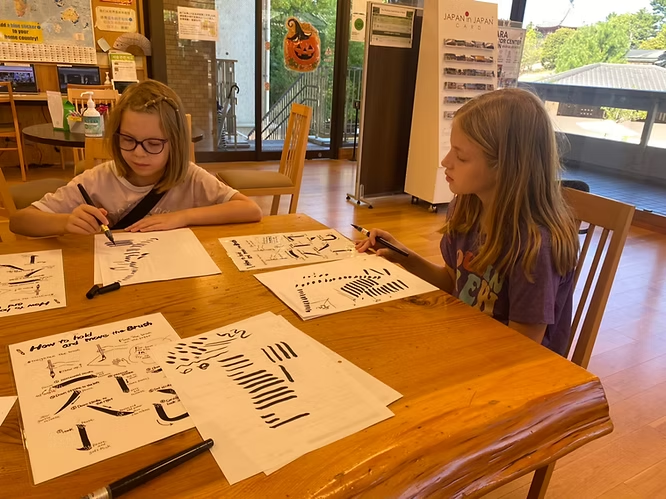
It's a nice, gentle warm-up before the busier parts of the day, and a good spot to pick up a free map or booklet covering the deer park, shrines, and temples. There are also bathrooms, which if you're travelling with kids, I'm sure you will appreciate!
Kofuku-ji Temple
From the Visitor Centre, continue on toward Nara Park and you'll come to Kofuku-ji, a former Fujiwara clan temple and one of the most important sites in the whole park. It's actually a cluster of buildings rather than a single temple, but two in particular stand out.
The first is the five-storied pagoda, which is 50 meters tall, making it Japan's second tallest wooden pagoda. It's one of the most photographed landmarks in Nara, and can be seen reflected in the waters of nearby Sarusawa Pond (see note below).

The second is the Chū-kondō (Central Golden Hall), right beside the pagoda and painted in vivid vermillion red. It's actually a fairly recent restoration, only fully reopened in 2018 after being rebuilt to match its original historic design, so it looks noticeably crisper and more colourful than the pagoda beside it.
A quick heads-up: the pagoda has been fully covered in scaffolding since 2023 for a major restoration project not due to finish until 2034, so you won't currently be able to see it, or get the classic reflection shot in Sarusawa Pond. Still worth a look at Sarusawa Pond and the Chū-kondō regardless.
Feed the Deer in Nara Park

This is what most people come to Nara for, and they're absolutely worth seeing, though we'll be honest, after an hour or so of being followed and nudged for crackers, the charm does start to wear a little thin.
That said, it's easy to see why they're such a popular attraction.
Over a thousand sika deer roam freely throughout Nara Park, and are considered sacred messengers in Shinto tradition and protected as a national natural treasure.
In fact many of the deer actually bow their heads if you hold a cracker up and wait, which is a pretty amazing thing to witness in person.

You can buy shika senbei (deer crackers) from small stands throughout the park for around ¥200 a pack, we'd suggest grabbing two, since they go quickly.
As delightful as it is to feed them, a quick word of warning: while the deer are gentle by nature, they are still wild animals, and things don't always go to plan.
Jessica found this out firsthand when she ran out of crackers a little too quickly and got headbutted by an impatient deer.
She was completely fine, if a little shaken, and spent the rest of the morning under our unofficial bodyguard protection!
If you're visiting with children, we'd recommend keeping a few things in mind:
Show your empty hands, palms out, the moment you're out of crackers. The deer seem to understand this as a clear "no more food" signal.
Try to feed a single deer away from a larger group where possible, the more deer competing for your attention, the higher the chance of pushing, nudging, or a headbutt from behind.
Avoid holding food above your head or backing away suddenly if a deer is behind you.
It's a genuinely fun experience, just don't let the cute photos fool you into thinking every deer will behave like a petting-zoo animal.
Yoshikien Garden

After feeding the deer, we took a short detour to Yoshikien Garden, a small, free-to-enter Japanese garden (free specifically for international visitors) made up of three distinct sections: a pond garden, a moss garden, and a tea ceremony garden.
It only took us around 20 minutes to walk through, but it offered a welcome break from the crowds around the deer and the busier attractions nearby.
We weren't able to fit it into our day, but the neighbouring Isuien Garden is another well-regarded garden worth considering if time allows.
Todai-ji Temple & the Great Buddha

Todai-ji is Nara's headline attraction, home to the Daibutsu, one of the largest bronze Buddha statues in the world, housed inside the Daibutsuden (Great Buddha Hall), long recognised as one of the largest wooden buildings on the planet.
The highlight inside is the Daibutsu, one of the largest bronze Buddha statues in the world, standing around 15 metres tall beneath the vast wooden interior of the Great Buddha Hall.
One of the hall's wooden support pillars has a hole cut through its base, said to be the same size as one of the Buddha's nostrils, and there's a long-running tradition of visitors (mostly kids) squeezing through it for good luck.
Note: Photography is prohibited inside the hall.
Outside the hall, don't miss the huge Nandaimon Gate, the temple's Great South Gate. It's home to two enormous guardian statues carved inside the gate, and well worth slowing down for in its own right.

Nigatsu-dō Hall

Just east of the Great Buddha Hall is Nigatsu-dō Hall, which is free to enter and has one of the best panoramic views over Nara.
It does involve a bit of a climb, around 70 stone steps up a wooded hillside, so it might not be suitable for everyone if your kids (or you) are already flagging by this point in the day.
Nigatsu-dō is also home to the Omizutori (Water-Drawing) Fire Festival, held each March. One of Japan's oldest continuously running Buddhist ceremonies, it features huge flaming torches carried along the hall's balcony after dark and is well worth considering if you're visiting at that time of year.
Kasuga Taisha Shrine

From Nigatsu-dō, a scenic 10-15 minute walk along forest pathways brings you to Kasuga Taisha, which is one of Japan's most important Shinto shrines and a UNESCO World Heritage Site.
The approach itself is lined with roughly 3,000 stone and bronze lanterns, donated by worshippers over the centuries.
The outer grounds are free to explore, with a small fee to enter the inner corridor. Deer tend to gather here too, often peeking out from behind the lanterns, so keep your camera ready!
Ukimido (Floating Pavilion)

This ended up being one of our favourite spots in Nara Park. Ukimido is a small pavilion set out over a pond, with turtles gliding beneath it and far fewer visitors, and deer, than almost anywhere else in the park.
It's not the flashiest stop on this list, but if you want a genuinely peaceful five or ten minutes away from the crowds, or a spot to sit down and have a quiet picnic, this is where we'd send you.
Mochi Pounding & Shopping at Mochiidono
If you're heading back toward Kintetsu Nara Station at the end of the day, it's worth swinging by Nakatanidou, a small mochi shop famous across Japan for its high-speed hand-pounding technique. Apparently the owners have actually won the national mochitsuki speed championship!
The shop sits right at the entrance to Mochiidono Center Gai, a covered shopping arcade lined with local shops, souvenirs, and food stalls, which is a nice easygoing way to end the day before heading back to the station.
There's no fixed schedule for the mochi pounding itself, it happens whenever the shop's stock runs low, but roughly every 30-45 minutes, and each performance only lasts a minute or two.
Nara Park Day Trip - Suggested One-Day Itinerary
This itinerary takes you through the best of Nara Park in a logical, walkable order, blending the famous bowing deer, historic UNESCO temples, a quiet garden, and a fun food stop to end the day. It's a wonderful way to spend a full day in Nara.
Nara Visitor Centre → Kofuku-ji Temple → Feed the Deer in Nara Park → Yoshikien Garden → Todai-ji Temple & the Great Buddha → Nigatsu-dō Hall → Kasuga Taisha Shrine → Ukimido (Floating Pavilion) → Mochi Pounding & Shopping at Mochiidono
Nara Visitor Centre (Start Here)
Begin your day just outside JR Nara Station. Take part in the free calligraphy and origami lesson, pick up a free park map, and use the bathrooms before you head in, it's a gentle, low-key way to start, especially with kids.
Kofuku-ji Temple
On your way into the park, take a few minutes at Kofuku-ji to see the five-storied pagoda and the vividly restored Chū-kondō side by side.
Feed the Deer in Nara Park
This is what most people come for, and they're absolutely worth seeing. Grab a couple of packs of shika senbei and watch the deer bow for their crackers, just keep your wits about you once the food runs out.
Lunch
We stopped for lunch at Vegan Friendly Ramen by Playpen Friends, which was great. Despite the name, it's not exclusively vegan, they also serve meat options, so it's a good choice whether or not you're looking for plant-based options.
Yoshikien Garden
A short, free detour off the main path. It only takes about 20 minutes to walk through, and it's a welcome, quiet break from the crowds around the deer.
Todai-ji Temple & the Great Buddha
Nara's headline attraction. Even if the queue for the Great Buddha Hall itself is too long, the Nandaimon Gate and its guardian statues are worth slowing down for on their own.
Nigatsu-dō Hall
Just east of the Great Buddha Hall, this one's optional. It's free, with one of the best panoramic views over Nara, but it does involve a genuine climb, so skip it if energy is already running low.
Kasuga Taisha Shrine
A scenic 10-15 minute walk through the forest brings you to Kasuga Taisha, one of Nara's most important shrines, with roughly 3,000 stone and bronze lanterns lining the approach.
Ukimido (Floating Pavilion)
Our quiet favourite of the whole day. A small pavilion over a pond with turtles gliding beneath it, and far fewer crowds and deer than anywhere else in the park, a great spot to sit and rest.
Mochi Pounding & Shopping at Mochiidono
On your way back toward Kintetsu Nara Station, swing by Nakatanidou for a chance to catch the famous high-speed mochi pounding, then browse the shops in the Mochiidono arcade before heading home.
This pacing gave us a full but comfortable day without feeling rushed, though if deer photos and Todai-ji are your main priority, a shorter half-day version focused just on those two is realistic too.
Final Reflections on Nara

Nara genuinely surprised us. Our thinking going in was pretty simple: was it worth taking time out of our Kyoto trip just for the bowing deer, which we already knew the kids would love? What we didn't expect was everything else, the temples, and just how much history is packed into a relatively compact area. In the end, we think Nara Park absolutely earns a full day of its own.
If you're coming from or heading to Tokyo or Kyoto and looking for some inspiration, check out our Tokyo itinerary and Kyoto itinerary, along with all of our other Japan content here.
We stayed at the Osaka Station Hotel, which was possibly the fanciest hotel of our entire trip to Japan. It's worth staying for the complimentary sake alone, not to mention the incredible futuristic toilets!
We're a Calgary-based family that travelled for 100 days, documenting each step so other families can get an honest, real-life look at long-term travel with kids.
You can browse the full 100-day daily diary contents list here.


Comments